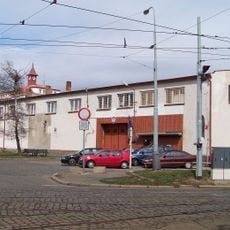
Pankrácká sekyrárna, Execution cells in Pankrác Prison, Prague, Czech Republic
Pankrácká sekyrárna is an execution chamber preserved within Pankrác Prison in Prague, housing an original guillotine from the World War II period. The space displays the physical layout and original equipment used, along with documentation spanning several decades of confinement and judicial proceedings.
The German occupation administration set up a police prison in Pankrác and, from 5 April 1943, used cells 29–31 as an execution site. Between then and 26 April 1945, executioner Alois Weiss and his assistants beheaded 1,075 people (920 men and 155 women) by guillotine. In early May 1945 the Germans dismantled the guillotine and threw it into the Vltava; divers recovered it two months later.
The three cells are named after the axe (sekyra) once used here, though the executions were carried out with a guillotine. The condemned were allowed to write a final letter in a preparation cell before execution, and the guillotine was hidden in the Vltava under Charles Bridge at the end of the war.
The three cells are part of the Pankrác Memorial, administered by the Documentation and History Cabinet of the Czech Republic Prison Service. Executions took place only on Tuesdays and Thursdays, always in the same order, starting at 8:30 with the reading of names. The guillotine was dismantled by the Germans on the night of 30 April to 1 May 1945 and thrown into the Vltava; divers recovered it two months later near the fourth bridge pier.
The guillotine was dismantled by the Nazis on the night of 30 April to 1 May 1945 and its parts thrown into the Vltava below Charles Bridge; divers recovered it two months later near the fourth bridge pier and it was returned to its place. The execution room was also packed with 360 kg of ecrasite, but the demolition failed.
The community of curious travelers
AroundUs brings together thousands of curated places, local tips, and hidden gems, enriched daily by 92,403 contributors worldwide.