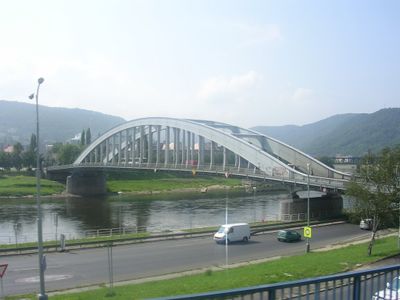
Most Dr. Edvarda Beneše, Road bridge in Ústí nad Labem, Czech Republic
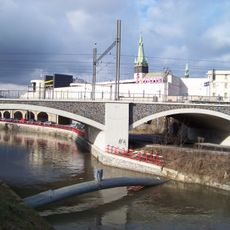
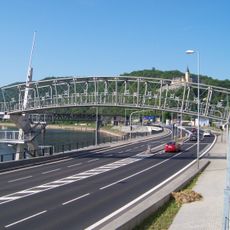
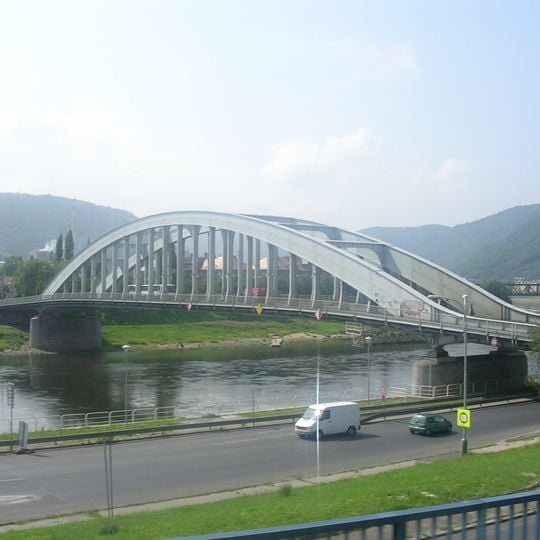
Most Dr. Edvarda Beneše is a steel road bridge over the Labe between Ústí nad Labem-město and Střekov, built in 1934–1936 to the design of engineer Josef Melan. Its steel arch, longitudinal and cross girders and columns carry a reinforced concrete deck; the roadway once had a wooden pavement of oil-impregnated pine blocks.
Plans for a second bridge in Ústí nad Labem date to 1908, with engineer Josef Melan's design approved in 1931 and construction running from 1934 to 1936, when the bridge opened on 9 August at a cost of about 15.7 million Kč. Renamed Hermann-Göring-Brücke in 1938, it was prepared for demolition at the war's end until soldier Josef Patz removed the explosives; it bore the name of Greek resistance fighter Nikos Belojannis from 1952 to 1990.
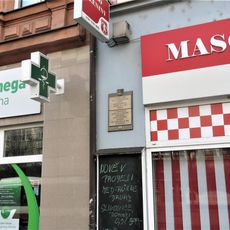
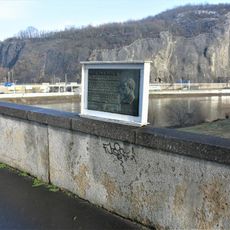
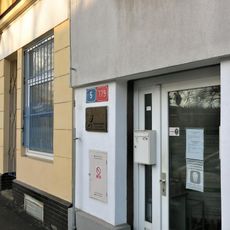
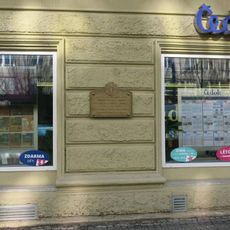
The bridge carried trams to Střekov and a toll was collected until autumn 1938, when the borderlands were ceded to Germany and the Nazi city administration abolished the toll by political decision. The name changed with each regime: Dr.-Edvard-Beneš-Brücke until 1938, Hermann-Göring-Brücke during the occupation, Most Nikose Belojannise from 1952 to 1990. A plaque placed on 31 July 2005 recalls the Ústí massacre, part of which took place on the bridge on 31 July 1945.
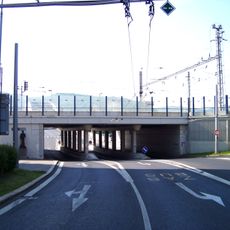
The bridge connects the districts of Ústí nad Labem-město and Střekov, allowing traffic for both vehicles and pedestrians across the river. It is designed for regular use and easy to navigate.
The wooden pavement of oil-impregnated pine blocks kept the deck light but turned slippery when wet; it stayed in place for over 30 years until the tram line over the bridge was closed in 1968 and asphalt replaced it. A memorial plaque added on 31 July 2005 recalls the Ústí massacre, part of which took place on the bridge on 31 July 1945.
The community of curious travelers
AroundUs brings together thousands of curated places, local tips, and hidden gems, enriched daily by 92,939 contributors worldwide.