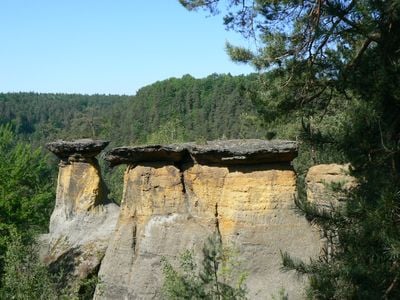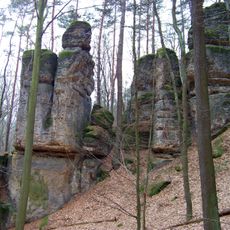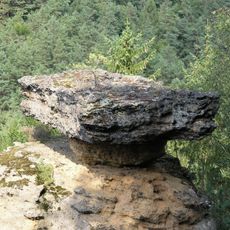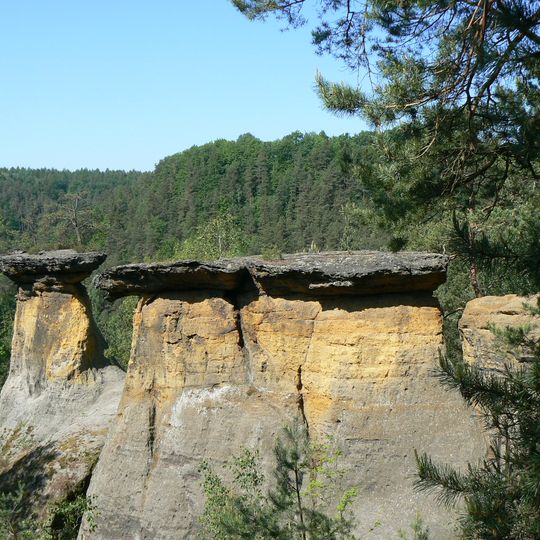
Mšenské pokličky, Sandstone rock formations in Kokořínsko Protected Landscape Area, Czech Republic.
Mšenské pokličky is a rock formation above the Kokořínský důl valley in the Mšeno cadastral area, at the mouth of the Močidla ravine between the Vojtěchov settlement and the Hlučov hamlet. Its caps are iron-rich coarse sandstones to conglomerates, in places over a metre thick, resting on irregular truncated cones of softer sandstone bound by kaolinitic cement. The largest cap measures about 6 × 5 × 1.5 m, and that formation stands roughly 12 m high.
These formations originated from sediments deposited during the Cretaceous period when an ancient sea covered the region roughly 90 million years ago. Over time, the sedimentary layers hardened into sandstone and were gradually shaped by erosion into the distinctive structures seen today.
The name pokličky means "little lids", after the iron-rich sandstone and conglomerate slabs, over a metre thick in places, that sit on softer kaolin-bound sandstone cones. The largest slab measures about 6 × 5 × 1.5 m on a formation roughly 12 m high. Nearby are embryonic shapes that will become pokličky as today's caps erode and collapse.
Mšenské pokličky lie on the blue hiking trail between Mšeno and Jestřebice. The nearest bus stop, Kokořín, Kokořínský důl, Pokličky, is about 250 m from the rocks. The formations stand above Kokořínský důl at the mouth of the Močidla ravine, between the Vojtěchov settlement and the Hlučov hamlet.
The largest cap measures about 6 × 5 × 1.5 m and sits on a cone roughly 12 m high. Nearby are embryonic forms that do not yet resemble caps; they will develop as today's caps erode and their top slabs collapse.
The community of curious travelers
AroundUs brings together thousands of curated places, local tips, and hidden gems, enriched daily by 94,040 contributors worldwide.