Pustý zámek, Gothic rock castle in Bukovec, Czech Republic.
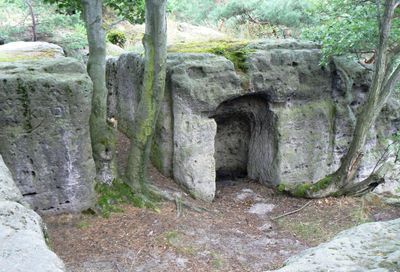
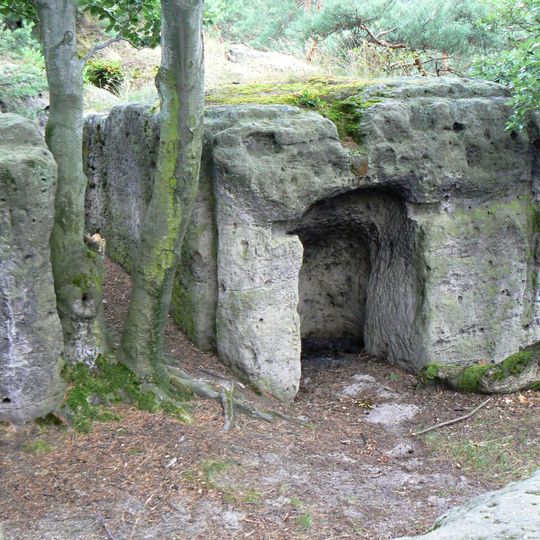
Pustý zámek is a rock castle ruin south of Zakšín near Dubá, built on a sloping pseudo-ridge of Turonian sandstone. Its core is divided into three sections separated by a ditch up to eight metres wide and a rock fissure; the buildings were partly cut into the rock, with timber dominating above ground and masonry documented only on the west side of the penultimate rock block.
Pottery fragments from the site date to the second half of the 13th to early 14th century and again to around 1400, suggesting two occupation phases separated by abandonment. The castle's history is tied to Zakšín, first recorded in 1402 as part of the Čap castle estate; Václav Berka of Dubá then used the title "of Zakšín", and his son Aleš inherited the village around 1430. From 1460 Zakšín is listed only as a village, joined to the Starý Berštejn estate by the Berkas at the end of the 15th century.
The castle's name, Pustý zámek (Wüstes Schloss), means "deserted castle" in both Czech and German. The site is protected as a cultural monument of the Czech Republic. The village of Zakšín, first mentioned in 1402, was held by the Berka family, who later adopted the predicate "of Zakšín".
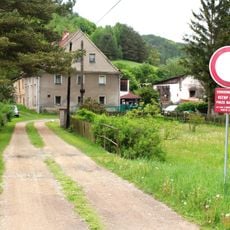
The ruins are reached on foot along the red-marked hiking trail running from Zakšín to the Rač junction and on to Nedvězí. The path follows the sandstone ridge, and the site itself has no facilities or information panels.
The castle core is split into three sections separated by a ditch up to eight metres wide, cut along a natural fissure and narrowed by three metres at the entrance, where a massive rock pillar remains. A pit for the counterweight of a drawbridge survives in the second section.
The community of curious travelers
AroundUs brings together thousands of curated places, local tips, and hidden gems, enriched daily by 94,370 contributors worldwide.