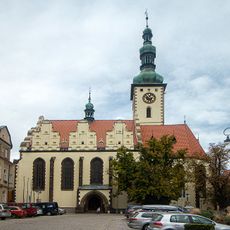
Old town hall in Tábor, Gothic town hall in Tábor, Czech Republic
The Old Town Hall of Tábor is a late Gothic structure with a tall tower and stone walls that rise prominently from the central square. The building displays typical features of its period including arched windows, decorative stone elements, and a clear vertical emphasis that distinguishes it from surrounding structures.
Construction of the town hall began at the end of the 15th century, after Tábor became a royal town in 1437, and was completed in 1521, as recorded on the staircase to the Gothic hall. Master Staněk, the stonemason, built it on the site of three demolished houses. Antonio de Alfieri made Baroque changes around 1679, an Empire facade followed in 1839, and Josef Niklas gave the building its Neo-Gothic form in 1874–1878.
The hall's net-vaulted ceiling rests on two octagonal pillars whose corbels carry carved human and animal motifs; tradition identifies two male heads as Jan Žižka and Prokop Holý, the best-known captains of the Tábor field armies. Above the main entrance a stone dated 1515 bears the town coat of arms framed by dry branches, with figures of Žižka, Jan Hus, Jerome of Prague and Adam and Eve, plus Wendel Roskopf's monogram.
The Hussite Museum occupies the building, and the medieval cellars under the north wing have been open to visitors since 1947; the entrance to the Tábor underground is on the ground floor. The Gothic hall and the tower clock are on the upper floors, reached by the open staircase of 1527 in the courtyard.
The town hall cellars connect to the Tábor Underground, a network of passages formed by linking the vaults of burgher houses with the town hall's own cellars beneath the north wing. The entrance to these passages is inside the building. The underground was opened to visitors in 1947.
The community of curious travelers
AroundUs brings together thousands of curated places, local tips, and hidden gems, enriched daily by 92,165 contributors worldwide.