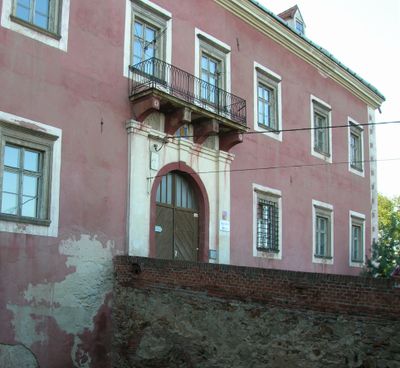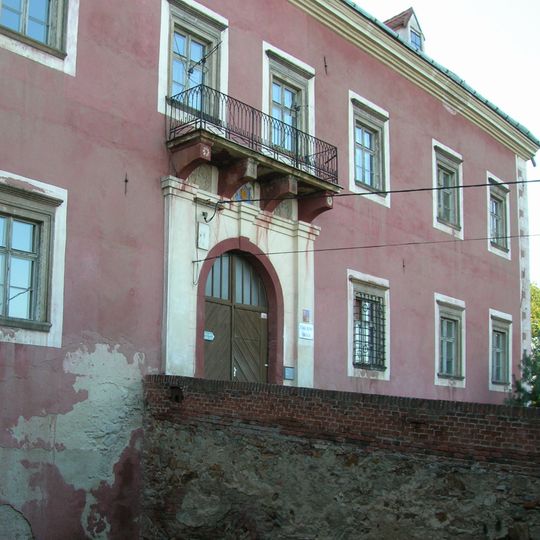
Sádek, Baroque château in Čáslavice, Czech Republic.
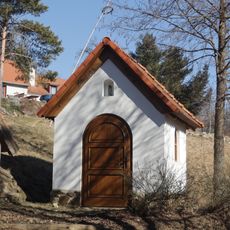
Sádek is a four-winged, single-storey château set on a conical hill at 568 m between Kojetice and Čáslavice. Its wings enclose a rectangular courtyard; two small cylindrical towers with stairs and ground-floor doors stand at the corners of the western side, where a chapel occupies the west part and the south wing holds a hall with classicist paintings of the region.
Sádek was first recorded in 1286 as the castle Ungersberg, held by Štěpán of Hungary. In 1312 Jan of Luxembourg took and razed it after its garrison looted the countryside. The Valdštejn family rebuilt it, and in the mid-16th century it was converted into a Renaissance château; after a lightning fire in 1694 it was remodelled in the Baroque style.
The name Sádek was used for the castle probably from the time of its Renaissance conversion; earlier forms were Sadek and Zadek, and the origin of the name is unclear, though it is not a diminutive of sad. The castle was also called Ungersberk, after the Hungarian-born Štěpán Ungar de Sadek, who likely had it built between 1239 and 1286.
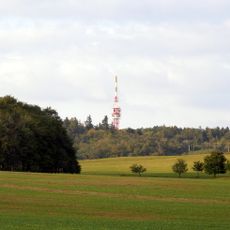
The château stands on a solitary conical hill at 568 m between Kojetice and Čáslavice, so the approach is on foot or by a hill road, not from the village centre. It is privately owned since 2010 and not open to the public; a five-year reconstruction was announced for 2019, with the basic work due to finish around 2026.
The building has been altered multiple times over nearly 8 centuries while maintaining its original brick construction. This continuity through different architectural periods is unusual and shows how structures adapted without losing their fundamental character.
The community of curious travelers
AroundUs brings together thousands of curated places, local tips, and hidden gems, enriched daily by 92,641 contributors worldwide.