Most Míru, Railway viaduct in Dolní Loučky, Czech Republic.
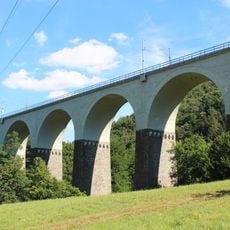
Most Míru is a railway viaduct in Dolní Loučky, spanning 282 m at km 37.099–37.381 of the Brno–Havlíčkův Brod line, with a maximum height of 42 m above the Libochůvka valley. Its 110 m reinforced-concrete main arch was the largest of its kind in Central Europe when built, and the pier faces are clad in granite blocks.
Construction of the viaduct began in summer 1940 for the Prague firm of Ing. Zdenko Kruliš, after the Loučský tunnel was driven from autumn 1939. A steel design was abandoned in 1941 for lack of steel, and the bridge was rebuilt as a concrete viaduct with granite-faced piers. Work stopped on 31 December 1943, resumed in 1950, and the structure was finished in August 1952; trains ran from 20 December 1953.
The bridge's name, Most Míru (Bridge of Peace), was given in the postwar period, and the line it carries was ceremonially opened on 20 December 1953. The structure is a local landmark above the Libochůvka valley, visible from the Dolní Loučky–Kuřimské Jestřabí road that passes beneath it.
The viaduct carries active train traffic and sits near the village of Dolní Loučky where it can be viewed from several vantage points. Best views are available from nearby road access points along the valley without needing to approach the railway line directly.
The 110-metre main arch was the longest reinforced-concrete arch in Central Europe when it was cast between 22 October and 22 December 1951. Its reinforcement weighed 190 tonnes, out of 420 tonnes for the whole bridge. The formwork rested on tubular scaffolding of 790 tonnes, the largest of its kind in the world at the time.
The community of curious travelers
AroundUs brings together thousands of curated places, local tips, and hidden gems, enriched daily by 94,243 contributors worldwide.