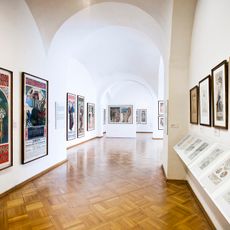
Kounic Palace, Baroque palace in New Town, Czech Republic.
Kounic Palace stands at Panská 890/7 in Prague's New Town, a baroque building with a garden and the adjoining Wittman House on Nekázanka. Its two-storey ceremonial hall, added in 1843–1844, has romantic murals illustrating the Nibelungenlied by Antonín Lhota, Rudolf Müller and Adolf Weidlich.
The core of the palace is a medieval burgher house first documented in 1437, when the soap-maker Vaněk bought it. The Schaffgotsch family had it rebuilt as a baroque palace in 1716–1720; a 1723 coronation commission recorded 25 rooms, a chapel, a library, four cellars and stables for twenty horses. Kašpar Předák added the two-storey ceremonial hall in 1843–1844, and the Kounic family bought the palace in 1861.
The palace is named after the Kounic (Kaunitz) counts, its last private owners, who bought it in 1861; the ground floor was then converted into shops. In the palace is a statuette by Karel Pokorný, made as a model for the large monument to Božena Němcová, whom Countess Eleonora Kounicová supported.
Kounic Palace stands at Panská 890/7 in Prague's New Town, near the Nekázanka corner, a short walk from Náměstí Republiky and Můstek metro stations. The building is rented to the Mucha Museum, while the other representative halls host concerts and receptions, so entry depends on the programme.
During the Prussian siege of Prague in 1757, several neighbouring houses burned down, but the palace survived the artillery fire undamaged. A 1723 inventory compiled for Charles VI's coronation records 25 rooms, a chapel, a library, four cellars and stables for twenty horses.
The community of curious travelers
AroundUs brings together thousands of curated places, local tips, and hidden gems, enriched daily by 92,165 contributors worldwide.