Calvary in Ostré, Sanctuary in Ostré, Czech Republic.
Calvary in Ostré is a Baroque pilgrimage complex on a hill of the same name, built from 1707 by Václav Růžička and attributed to architect Octavio Broggio. A terrace with fragments of sandstone statues of the kneeling Jesus and apostles, symbolising Gethsemane, leads via a monumental sandstone staircase to three chapels: two identical tower-shaped side chapels and, between them, the low longitudinal Chapel of the Holy Sepulchre.
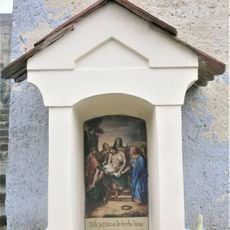
Václav Růžička, steward of the Jesuit estate at Liběšice, had the complex built from 1707 into the second decade of the 18th century; the design is usually attributed to the Baroque architect Octavio Broggio of Litoměřice. The fourteen Stations of the Cross chapels lining the approach path date from the early 19th century. Since 2005 the Společnost pro obnovu památek Úštěcka has worked to halt decay, and in 2011 the Stations of the Cross were fully restored, paintings included.
The name Kalvárie refers to Golgotha, and the hill is also called Kostelíčky ("little churches"). The Stations of the Cross chapels date from the early 19th century, and the terrace on the western slope stands for the Garden of Gethsemane, with torsos of Baroque sandstone figures of the kneeling Jesus and the apostles.
Access is on foot via marked trails that wind through the site and lead upward along the slope. Wear comfortable shoes as the paths involve climbing and multiple stops along the pilgrimage route.
The two side chapels on the summit, the Chapel of the Finding and the Chapel of the Exaltation of the Holy Cross, are identical in their tower-like form, while the low longitudinal Chapel of the Holy Sepulchre stands between them. Their twin silhouettes are visible far across the Úštěk region.
The community of curious travelers
AroundUs brings together thousands of curated places, local tips, and hidden gems, enriched daily by 94,497 contributors worldwide.