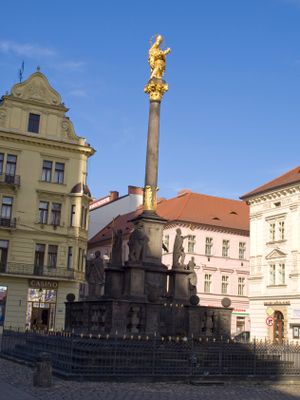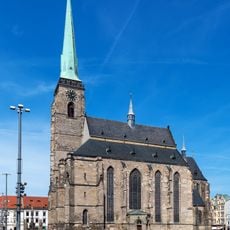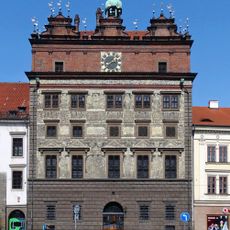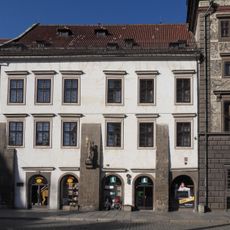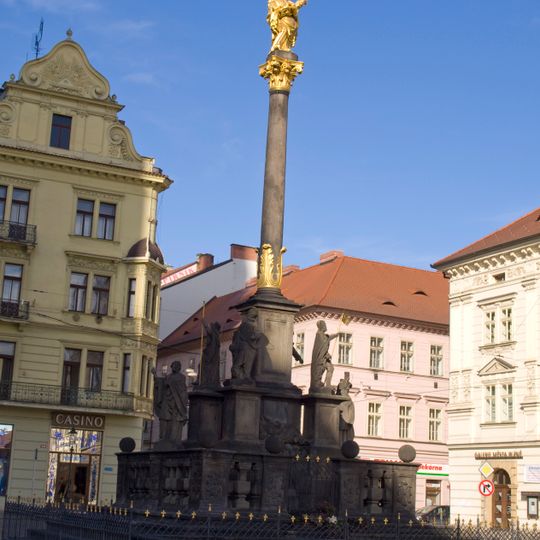
St. Mary's plague column, Baroque plague monument in Republic Square, Plzeň, Czech Republic
St. Mary's plague column stands in the northwest corner of Republic Square, before the Imperial House. Its three-tiered base rises from a square platform enclosed by a balustrade with six steps, and the column carries a crowned Madonna and Child facing east, a free replica of the Gothic Plzeň Madonna.
On 22 September 1680 the city council vowed during a procession on Republic Square to erect a column to the Virgin Mary to end the plague; foundations were dug from 24 October and the foundation stone laid on 7 November by archdeacon Alexius Čapek, mayor Pavel Martinec and master Cyprian Frozín. Stonecutter Jan Milich, sculptor Kristián Widmann and mason Martin Novák completed it in 1681. A marble plaque placed in 1931 records the 1681 construction and repairs of 1890 and 1931.
The column displays eight saint statues including St. Wenceslas and St. Barbara, representing protection against disease and misfortune. These figures show how people expressed their faith in divine protection during times of hardship.
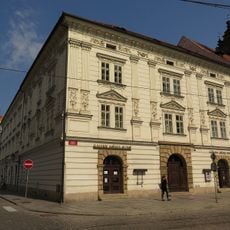
The column stands in the northwest corner of Republic Square, in front of the Císařský dům. Six steps and a balustrade with a front gate, added in 1891, separate the base from the paving; the gate faces east. The square is pedestrian ground, so the monument is reached on foot.
Among the eight saints, Saint Rosalie stands out as an unusual choice, as she was primarily venerated in southern Italian regions, revealing the city's far-reaching religious connections. This surprising saint underscores how local plague monuments reflected broader spiritual networks of the era.
The community of curious travelers
AroundUs brings together thousands of curated places, local tips, and hidden gems, enriched daily by 92,375 contributors worldwide.