Church of Saint Paul, Romanesque Revival church in Usti nad Labem, Czech Republic
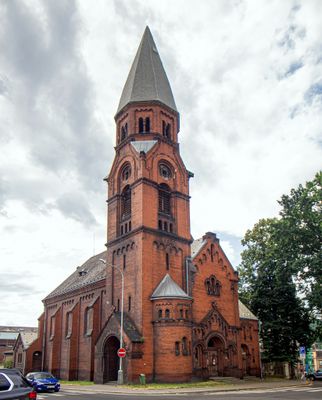
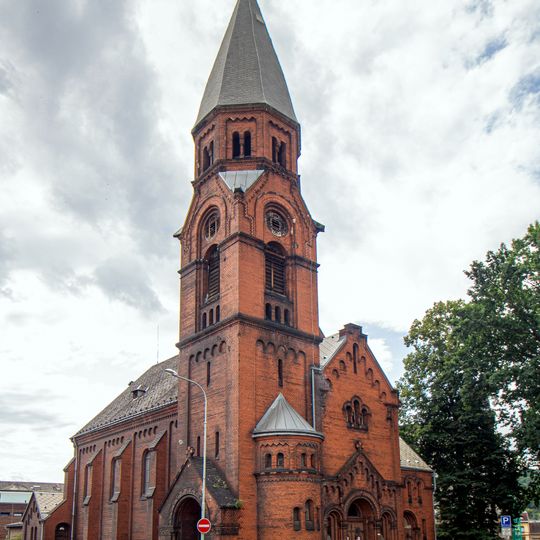
The Church of Saint Paul is a Romanesque Revival church with Secession details, built 1904–1906 to plans by Leipzig architect Julius Zeissig. It has a single asymmetrically placed 40-metre tower, a semicircular apse, round-arched windows and a fronton above the portal. Its brick-red facade is not brick but concrete with red tiles imitating brickwork, hence the nickname Red Church.
An evangelical congregation was founded in 1873 as a branch of Teplitz and became an independent parish in 1878. In 1902 its presbytery held an architecture competition won by Leipzig architect Julius Zeissig; the Gustav-Adolf-Verein helped fund the church, built 1905–1906 by local master builder Alwin Köhler.
The building serves as a shared house of worship where two Protestant denominations hold services and maintain their spiritual life together. It remains an active religious center for the local community.
The church stands at the corner of Horova, Bratislavská and Churchillova streets in the city centre. Sunday services are held in the church outside the winter months, when both congregations move to their parish prayer rooms: the Evangelical Church of Czech Brethren at 9:30 and the Czechoslovak Hussite Church at 15:00.
The red facade is not brick: red tiles were glued onto concrete walls to imitate masonry, which earned the church its nickname "Red Church". The vault over the nave, 12.4 m wide, was the first use of Franz Visintini's prestressed reinforced-concrete truss system for a church ceiling, a technology previously reserved for railway bridges.
The community of curious travelers
AroundUs brings together thousands of curated places, local tips, and hidden gems, enriched daily by 92,207 contributors worldwide.