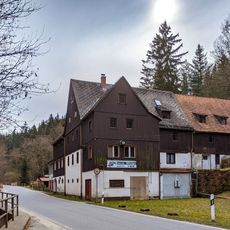
Králův mlýn, Religious hermitage in Maxičky, Czech Republic
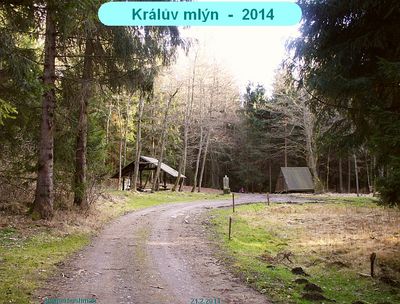
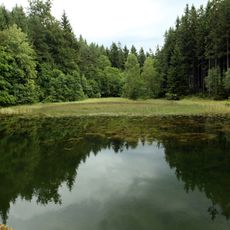
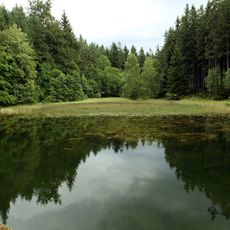
Králův mlýn is a former sawmill and inn site in the forest northwest of Maxičky, now marked by ruins, a restored short millrace and a working model of a water wheel. A shelter for visitors stands near the Napajedla stream, and the millpond lies about 400 metres away.
First documented in 1577 as a sawmill, the site predates the Maxičky settlement. Rudolf von Bünau settled two gardeners here in 1624 to keep the Salt Road branch running, but the hamlet and sawmill were destroyed in 1632 during the Thirty Years' War. The Thun forest administration built a new sawmill and forester's lodge in 1826–1827; the mill ran until 1872 and its dilapidated building was demolished in 1895.
The name Königsmühle, German for King's Mill, recalls the site's origins as a royal sawmill. From 1860 the forester could serve refreshments, and in 1897 his successor obtained a beer licence, founding an inn that drew hikers from both the Saxon and Bohemian sides.
The site lies northwest of Maxičky on the Napajedla stream, about 400 m from the pond Rybník u Králova mlýna. A shelter for visitors and a short millrace with a working water-wheel model stand near the ruins. Six drinking-water springs are accessible in the valley, including Křenkův pramen and Studánka sedmilhářů.
Visitors often discover a working water wheel model that local scouts rebuilt in the 1990s based on historical plans. This small technical reminder shows how water power once drove the site's original operations.
The community of curious travelers
AroundUs brings together thousands of curated places, local tips, and hidden gems, enriched daily by 94,154 contributors worldwide.