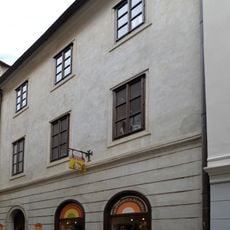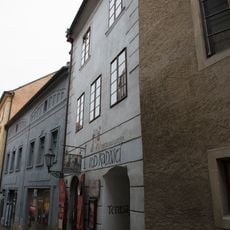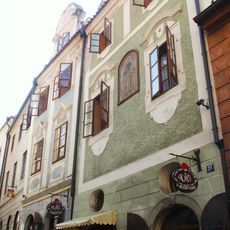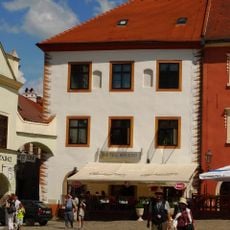
Town hall, Renaissance town hall at Namesti Svornosti square, Czech Republic
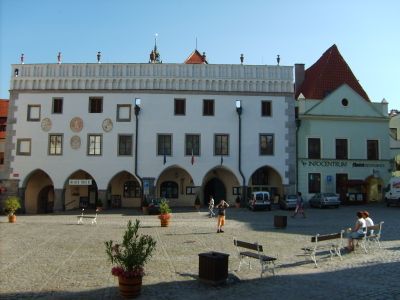
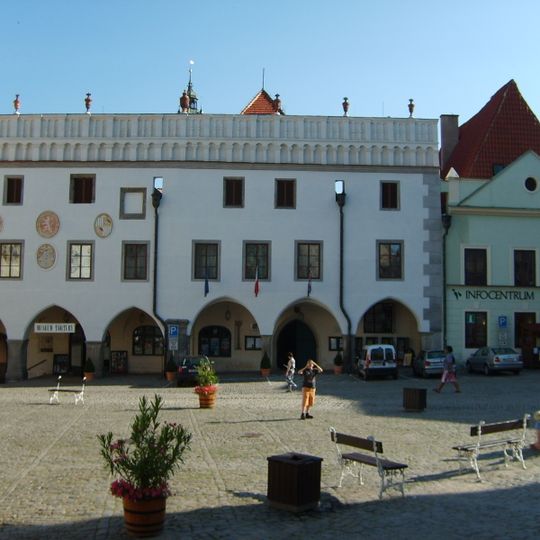
The town hall of Český Krumlov is a three-storey asymmetrical building on Svornosti Square, formed by joining two originally Gothic houses. Its south façade has a late Gothic arcade of six pointed arches on chamfered prism pillars, and the attic with two bands of pilasters and terracotta vases hides three saddle roofs set perpendicular to the façade.
The plot was built on by the early 14th century; house No. 1 belonged to the Zlatá Koruna abbot from 1309, and house No. 2 served as the town hall. In 1597 the municipality bought No. 1 from the merchant Andreas Teufel and joined both Gothic houses, adding part of No. 24 at the rear. The arcaded gables were replaced in 1796 by the two-band attic with terracotta vases.
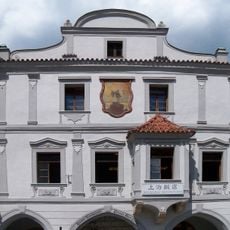
The Gothic entrance portal carries a painted shield with the five-petalled Rosenberg rose, and the façade bears four stucco coats of arms: the town of Český Krumlov, the Czech lands, the Eggenbergs and the Schwarzenbergs. A plaque on the building honours nine local airmen of World War II, and flowers are laid there on liberation anniversaries.
The municipal office occupies the building, and the Museum of Torture is housed in the vaulted cellars beneath most of it, reached from the vaulted hall where 15th-century wall paintings were uncovered in 2000. The arcade loggia facing Svornosti Square is open to passers-by. The entrance is a pointed Gothic portal topped by a painted five-petalled Rosenberg rose.
The attic hides three saddle roofs set perpendicular to the façade, so the building is deeper than its front suggests. In the upper left corner, just below the attic, hangs a small bell. Writer Rudolf Slawitschek compared the town hall to the Doge's Palace in his novel Modrý Pánbůh.
The community of curious travelers
AroundUs brings together thousands of curated places, local tips, and hidden gems, enriched daily by 92,284 contributors worldwide.