Burg Šenkenberk, Castle ruin in Šumná, Czech Republic
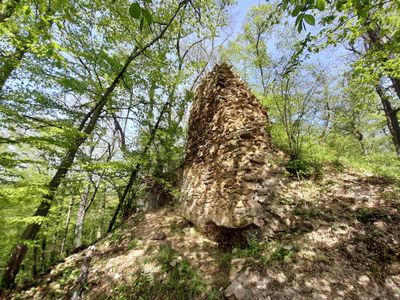
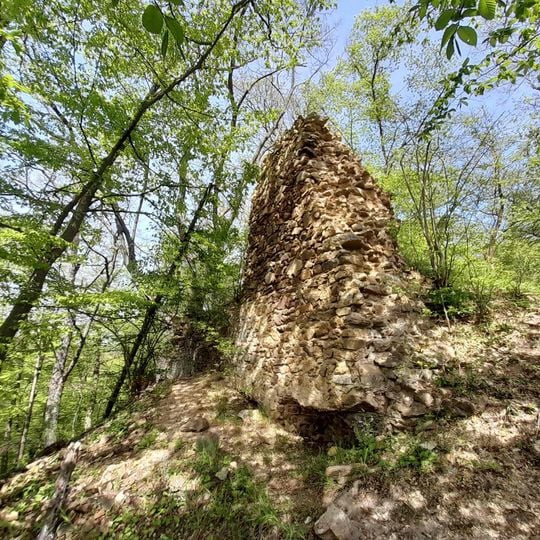
Burg Šenkenberk is a ruined spur castle on a rocky promontory at 412 m above sea level, three kilometres northwest of Olbramkostel in the Šumná cadastre. The site is divided into a trapezoidal core and a trapezoidal outer bailey, separated by a ditch; a neck ditch 9 m wide and 1.5 m deep cuts it off from the ridge to the east. The best-preserved part is the northern corner, where the wall stands up to 3.6 m high.
The castle was founded in the mid-13th century by the Austrian Schenk family, with Wolfram Schenk, royal burgrave of Frain from 1239, considered its first owner. It was first documented in 1325, when King John of Luxembourg permitted Hrut of Ruckstein to sell Chlupice to Henry of Schenkenberg. The castle fell into ruin probably during the Hussite Wars or the Bohemian-Hungarian War; the village below was deserted by 1549.
The name Schenkenberg comes from the Austrian Schenk family, whose first known member, Wolfram Schenk, is credited with founding the castle in the mid-13th century. The nearby village of the same name died out with the castle and was recorded as deserted from 1549. The ruin is freely accessible and protected as a cultural monument since 1958.
Marked hiking trails lead from Šumná village up to the ruins, offering access to a viewpoint overlooking the surrounding countryside. The terrain is sometimes steep and requires sturdy footwear, especially in wet conditions.
The castle was a two-part spur fort: a trapezoidal core with a bailey of the same shape, cut off by a 9 m wide and 1.5 m deep neck ditch. The best-preserved section is the northern corner, where the wall still stands up to 3.6 m high.
The community of curious travelers
AroundUs brings together thousands of curated places, local tips, and hidden gems, enriched daily by 92,781 contributors worldwide.