Libouchec, Renaissance château in Libouchec, Czech Republic
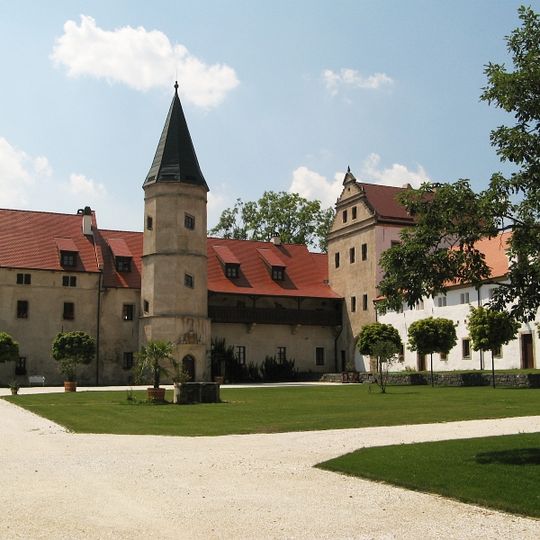
Libouchec is a Renaissance château founded after 1579 by Günter von Bünau. The two-wing, single-storey building stands at the northwest corner of a farmyard; both wings were linked at first-floor level by a gallery, of which two decorative corbels survive. The south wing has barrel-vaulted cellars, the ground-floor rooms have cross vaults, and the upper floor is flat-ceilinged.
A Gothic fortress, probably built in the 14th century when Libouchec belonged to the Vartenberk family, preceded the château; it stood on the site of house no. 175 and its remains vanished in the 1970s. After 1579 Günter of Bünau founded the Renaissance château. In 1628 Rudolf the Elder of Bünau sold the estate to Kryštof Šimon of Thun for 73,000 Rhenish guilders, and officials then resided there. A fire in 1872 led to reconstruction for residential and farm use.
The château's name comes from the village of Libouchec, first documented in 1169 as Königswald. Since 2003 it has been owned by the company Polesí Střekov, which allows guided tours and social events in the building. The two wings were once linked at first-floor level by a gallery, of which two decorative corbels survive.
The château stands at the edge of the central part of Libouchec, in the northwest corner of a former farmyard. It is not open to the public, but the owner, the company Polesí Střekov since 2003, allows guided tours and social events by arrangement.
The two wings of the one-storey château were linked at first-floor level by an outdoor gallery (pavlač); two carved corbels that carried it still survive on the façade. The south wing's cellars are covered by barrel vaults, while the ground-floor rooms have cross vaults and the upper rooms flat ceilings.
The community of curious travelers
AroundUs brings together thousands of curated places, local tips, and hidden gems, enriched daily by 92,682 contributors worldwide.