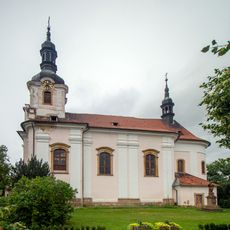
Cítoliby Castle, Baroque château in Cítoliby, Czech Republic.
Cítoliby Castle is a baroque building in Cítoliby, Louny District, formed by two Renaissance wings (northern and eastern) extended and joined by a new southern wing. Construction ran from 1665 to 1684 under Giovanni Battista Bolla and then Tommaso Pinchetti. The remains of an older fortress survive as a transverse wall in the cellars.
A fortress stood in Cítoliby by 1462, when Bavor z Třebívlic wrote of himself as seated there; its remains survive as a cross wall in the castle cellars. In 1569 Adam Hruška z Března bought the estate for 7,600 kop of Meissen groschen and built a Renaissance residence. From 1665 Jan van der Croon's contract with Italian stonemasons began the Baroque rebuilding, carried on until 1684 under Giovanni Battista Bolla and then Tommaso Pinchetti.
Under Arnošt Karel Pachta (1718–1803) the castle became a music centre where the Cítoliby composers' school was performed, with works by Karel Blažej Kopřiva, Jan Adam Gallina and Jakub Lokaj. Pachta founded a court orchestra and required applicants to read music and play an instrument. He sent gifted subjects to study with Prague composers. The castle chapel's activity ended at the end of the 18th century during the Napoleonic wars.
The castle sits about 2 kilometers from Louny and is currently listed as an endangered cultural monument. Preserving the building requires careful attention, so visitors should exercise caution when exploring the grounds.
In 1907 Jan Nepomuk II of Schwarzenberg removed the entire set of about fifty statues from the castle garden, including the balustrade, to his Neuwaldegg estate near Vienna, where they were restored and remain. Art historian Pavel Preiss attributes most of them to the workshop of Matyáš Bernard Braun; they depict dwarfs, putti and allegories of the Continents and Elements.
The community of curious travelers
AroundUs brings together thousands of curated places, local tips, and hidden gems, enriched daily by 93,783 contributors worldwide.