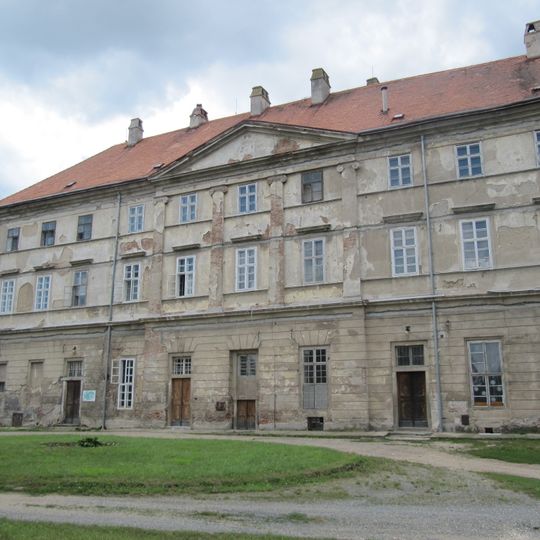
Drnholec Castle, Renaissance château in Drnholec, Czech Republic
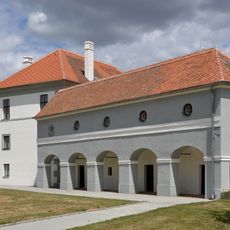
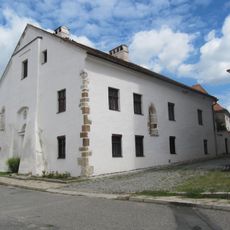
Drnholec Castle is a two-storey Renaissance palace of irregular rectangular plan on a rocky spur above the left bank of the Dyje. Its classicist facade has a three-axis risalit with pilasters and a triangular pediment facing the courtyard, and a brick Renaissance bridge from 1578–1582 leads to a three-axis gate, probably by Antonio Silva and Elia Canevale.
A castle probably stood here by the 1240s and was first documented in 1277, held in the mid-13th century by Vilém and Oldřich of Drnholec. The Lichtenštejns acquired it at the end of the 14th century and began rebuilding it in the 16th century against Turkish raids. In 1578 Kryštof of Tiefenbach bought the estate and around 1585 had the fortress rebuilt as a two-storey Renaissance château on an L-shaped plan, with Italian stonemasons Antonio Silva and Elia Canevale taking part.
The name Drnholec comes from the village's founding family, Vilém and Oldřich z Drnholce, who held the castle in the mid-13th century. The Renaissance gate of 1578–1582, probably by Antonio Silva and Elia Canevale, still frames the approach over a brick bridge across the moat. Inside, the ground floor keeps late-Renaissance stuccowork from the end of the 16th century.
The castle stands on a rocky spur above the left bank of the Dyje, on the eastern edge of Drnholec. Access is via a brick Renaissance bridge over the moat, followed by a three-axis Renaissance gate built in 1578–1582. The decaying building is privately owned and has long been offered for sale, so it is not open for regular visits.
The Renaissance gateway on the brick bridge over the moat dates from 1578–1582 and is attributed to the Italian stonemasons Antonio Silva and Elia Canevale, the same masters who worked on the castle. The bridge and gate form the entrance front rather than the palace itself.
The community of curious travelers
AroundUs brings together thousands of curated places, local tips, and hidden gems, enriched daily by 94,498 contributors worldwide.