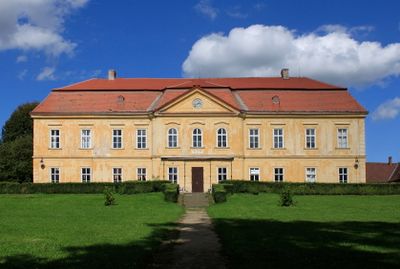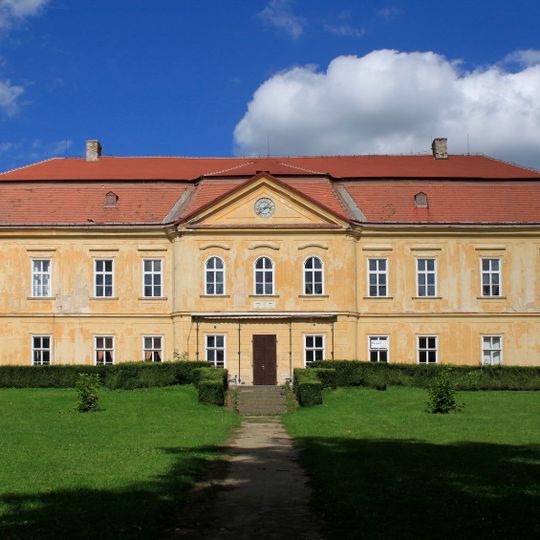
Dukovany Castle, Cultural monument in Dukovany, Czech Republic.
Dukovany Castle is a one-storey early Neoclassical château built in 1790 on an older manor house, with a rectangular two-wing plan. Gabled projections rise on the long sides, and a portico with balcony fronts the north entrance. U-shaped single-storey farm wings enclose the forecourt; façades have a string course, pilasters and window surrounds.
In 1790 Countess Marie Brigita Malabaile-Canalová, wife of botanist Josef Emanuel Canal, had an older manor of unknown origin rebuilt into the present early Neoclassical château. The Brno master builder Jan Amon added the portico, reworked the façades and interiors, and built the side farm wings. In the mid-19th century the estate passed to Count Rudolf Filip Josef Stadion-Warthausen, then to his daughter Gisela.
The sala terrena on the ground floor of the main building is painted in al secco with motifs of romantic architecture and exotic landscapes, probably by Václav Waitzman. Above it, the first-floor hall has grisaille paintings of ancient gods and heroes from 1791 by Josef Winterhalder and Václav Waitzman.
The castle stands in the northern part of Dukovany village, in the Třebíč district. Guided tours present first-floor rooms such as the countess's dining room and the gentlemen's salon, including a display of Czech presidents' dinner services. Restaurant service and overnight stays ended at the close of 2021, so check opening before travelling.
The castle's sala terrena on the ground floor holds an al secco painting from the early 1790s showing romantic architecture and exotic landscapes, probably by Václav Waitzman. Above it, the first-floor hall has grisaille paintings of ancient gods and heroes from 1791 by Josef Winterhalder and Václav Waitzman.
The community of curious travelers
AroundUs brings together thousands of curated places, local tips, and hidden gems, enriched daily by 92,668 contributors worldwide.