Town hall, Late Neoclassical town hall in Dubá, Czech Republic
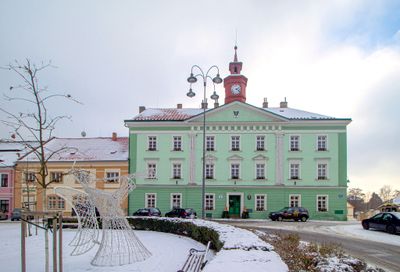
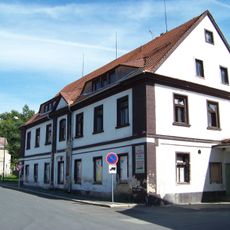
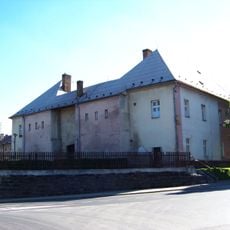
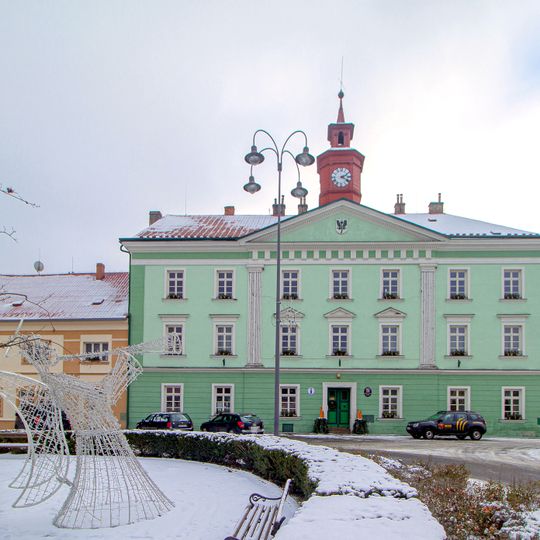
The town hall in Dubá is a late Neoclassical brick building of two storeys, completed in 1851 on the square's south-western side. Seven window axes divide the facade, whose central risalit carries pilasters, a dentilled tympanum with the town coat of arms, and a Latin inscription dated DCCCLI. A wooden polygonal tower with four clock faces rises above the tiled saddle roof.
The old town hall burned down in the fire of 1845 and was never rebuilt. After Dubá gained a district authority and district court in 1848, construction of a new town hall began in 1850 on the southwest side of the square near Poštovní street, and the building was completed and consecrated in 1851. Because it also housed the district court, prison cells were set up on the ground floor. The Latin inscription in the tympanum reads "VIRIBUS UNITIS CIVES DUBENSES DCCCLI" ("By the united efforts of the citizens of Dubá 1851").
The Latin inscription "VIRIBUS UNITIS CIVES DUBENSES DCCCLI" in the tympanum records that the town's citizens built it by united effort in 1851. The former prison cells on the ground floor, once fitted with original heating, now serve as the exhibition space Galerie Šatlava. The municipal information centre occupies the ground floor.
The building can be viewed from outside and its symmetrical Renaissance facade is clearly visible from the street. It is easily accessible on foot when walking through the town center, where other local shops and places are also nearby.
The tower keeps a 19th-century clock movement from the Vienna workshop of Rudolf Gschürtz, and the former prison cells on the ground floor, fitted with their original heating, now serve as the exhibition space Galerie Šatlava.
The community of curious travelers
AroundUs brings together thousands of curated places, local tips, and hidden gems, enriched daily by 92,722 contributors worldwide.