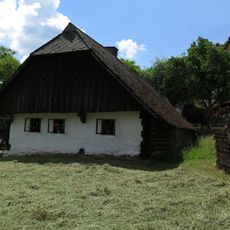
Běhařov, Baroque château in Běhařov, Czech Republic.
Běhařov is a small Baroque château standing on a gentle slope in a park-like grounds enclosed by a stone wall with a gate on its north side. The building has a rectangular plan and a triple mansard roof, from which rises a turret with an onion dome. Gothic and Renaissance vaults survive in the masonry; the ground floor is barrel-vaulted and the corridor has a cross vault.
A fortress stood at Běhařov from the 14th century, when the village was split among the estates of Bušek, Lvík and Sezema of Běhařov. Count Karel Heřman Koc of Dobrš bought the estate by 1651 and attached it to Bystřice, so the fortress lost its role as a noble seat. The Hubati family of Kotnov, owners from 1738, rebuilt the old fortress into a small Baroque château in the mid-18th century. Its present form dates from 1923–1927, when painter Alois Kalvoda, who bought it in 1918, had it altered.
The château's park holds sculpture tied to Czech art: Josef Drahoňovský's bronze Píseň našich hor, František Úprka's Pasačka on the fountain, and Jan Štursa's Dívčí akt. The grounds also contain a gatekeeper's house, a statue of Saint Wenceslas, a wine cellar and a Marian niche.
The château stands on a gentle slope in a park-like grounds enclosed by a stone wall, with the gate in its northern section. The grounds also hold a gatekeeper's house, a wine cellar, a statue of St. Wenceslas, a Marian niche, and a pool with a ford. In the second half of the 20th century the grounds were used by the Klatovy district institute of national health.
The château park holds three sculptures that visitors often miss: Josef Drahoňovský's bronze Píseň našich hor, František Úprka's Pasačka set on a fountain, and Jan Štursa's Dívčí akt. The grounds also contain a gatekeeper's house, a wine cellar, a niche with a Virgin Mary statue, and a pool with a ford.
The community of curious travelers
AroundUs brings together thousands of curated places, local tips, and hidden gems, enriched daily by 93,611 contributors worldwide.