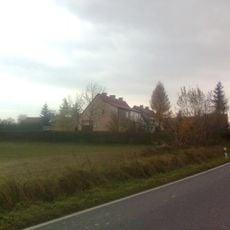
Vidnava Castle, Renaissance château in Vidnava, Czech Republic
Vidnava Castle is a single-storey building of rough stone with smooth plaster, rectangular in plan at 26 by 13 metres, with two square corner towers of 7 by 7 metres under tent roofs. The towers carry surviving sgraffito on their second floor, and the south side joins the remains of the town wall. Inside, the ground-floor hall has three bays of cross-rib vaulting with stuccoed ribs.
The first written record dates from 1291, when Bishop Tomáš II of Wrocław confirmed privileges granted to locator Rüdiger Heldore, who built a fortress outside the town walls. Burned by the Hussites in 1428 and again in 1468, it was rebuilt by merchant Jáchym Reideburg in 1559 as a Renaissance château with two corner towers. The Hentschel family held it until 1906, when it was sold to the town.
Since 1992 the building has housed the Základní umělecká škola Karla Ditterse, named after Karel Ditters of Dittersdorf. The school moved in after repairs carried out between 1967 and 1974. On the garden wall hangs a memorial plaque to the composer Eduard Schön, a native of Světlá Hora who wrote under the pseudonym Engelsberg.
Vidnava Castle stands on Kostelní Street (čp. 1), just south of the town square and beside the Church of Saint Catherine, within the Vidnava town heritage zone. The building is used by the Karel Ditters Art School, so it is best viewed from the street and the adjacent park rather than entered freely.
The castle's western boundary wall preserves a late Gothic 15th-century portal shaped like a donkey's back. The section adjoining the parish church collapsed in 1758, and the northern wall was demolished after 1906. A memorial plaque to composer Eduard Schön, a native of Světlá Hora who wrote under the pseudonym Engelsberg, is mounted on the wall.
The community of curious travelers
AroundUs brings together thousands of curated places, local tips, and hidden gems, enriched daily by 92,713 contributors worldwide.