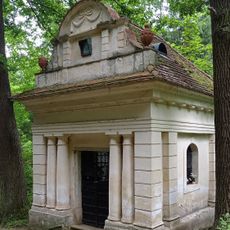
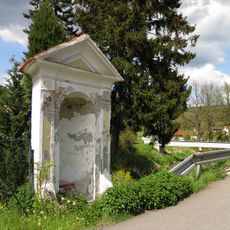
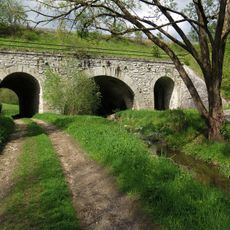
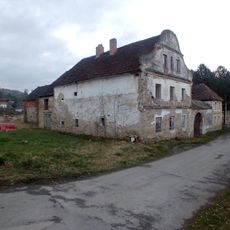
Kvítkův dvůr, Cultural monument and homestead in Latrán, Czech Republic.
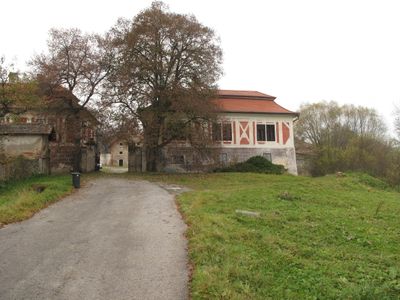
Kvítkův dvůr is a former farmstead about one kilometre west of Český Krumlov Castle, on the old road towards Kájov. Its surviving form comes from a Rococo rebuilding after 1750, when the east wing was converted into a small chateau. The single-storey building has walls painted with red quoining and white joints; the hall and cabinet of Princess Maria Theresa of Schwarzenberg hold frescoes by František Jakub Prokyš.
Founded before 1347 as a private farm called Piedíkův dvůr, it supplied Český Krumlov Castle with agricultural produce from the Middle Ages. It was plundered in 1422, when cattle were stolen at night, and after Nový Dvůr was set up near Český Krumlov in 1500 it was called the old court. In the 1560s it was probably rebuilt under Rožmberk regent Jakub Krčín; in 1750 Maria Theresa of Schwarzenberg had its east wing converted into a small chateau, and from 1950 state farms took it over.
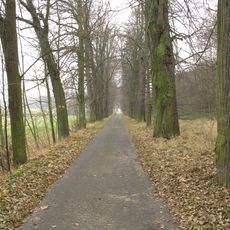
The name comes from the personal name Kvítek; the farm was earlier called Piedíkův dvůr (curia Piedikonis). After Maria Theresa of Schwarzenberg acquired it in 1750, the estate was known as the Favoritenhof, the favourite court, and she had an avenue of trees planted linking it to the castle garden at Český Krumlov.
Kvítkův dvůr lies about one kilometre west of Český Krumlov Castle on the old road towards Kájov, on the eastern slope of Liščí díra. The site is open to the public. The interiors with the Prokyš frescoes, historic windows, doors, vaults and stone portals are under heritage protection, so access to the decorated hall and cabinet may be limited.
The eastern wing was rebuilt after 1750 as a small chateau to designs by Josef Fortini, and in 1757 František Jakub Prokyš painted its hall and the princess's cabinet with scenes of country life. The farmstead was then called Favoritenhof, the favourite court.
The community of curious travelers
AroundUs brings together thousands of curated places, local tips, and hidden gems, enriched daily by 92,993 contributors worldwide.