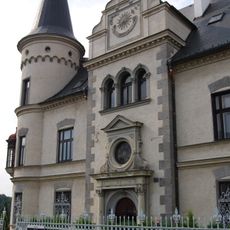
Bílkova vila, Cultural monument in Tábor, Czech Republic
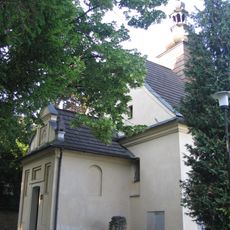
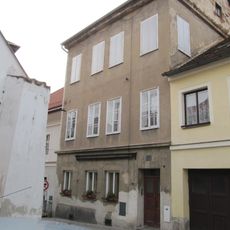
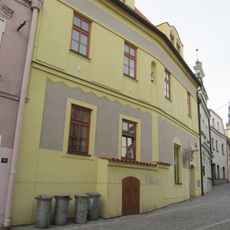
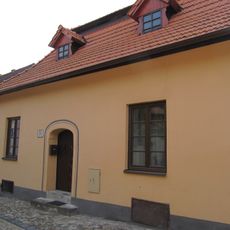
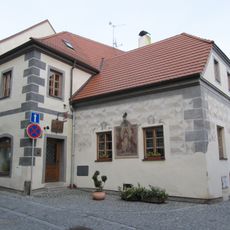
Bílkova vila, also called Vila Mária, is a two-storey terraced house on a sloping plot between Nováková and Příběnická streets in Tábor. Built on the border of Secession and Symbolism, it shows the early influence of Brussels-Paris Art Nouveau. The southern half is basemented, with an elevated ground floor holding the main living rooms and a residential attic above. A stone staircase inside has railings decorated with floral Secession motifs, and a stylised wasp's head appears on the gable and basement window grilles.
The villa was built in 1901 on a sloping plot between Nováková and Příběnická streets. The Tábor builder T. Brdlík designed it and in 1900 invited the artist František Bílek to collaborate; Bílek created the decorated facades and the artistic elements inside. It has been listed as a cultural monument since 2007.
The villa's name, Vila Mária, is not explained in the sources, but its decoration is: a stylized wasp's head appears on the gable and on the grilles of the basement windows, an apotropaic motif meant to protect the house from evil. Inside, a stone staircase with richly decorated railings carries Secessionist floral motifs, and many valuable craft elements survive.
The villa stands on a sloping plot between Nováková and Příběnická streets in Tábor; the entrance is on Příběnická, house number 738. The southern half is basemented, with the main living rooms on an elevated ground floor and a residential attic above. A sloping garden lies behind the house.
On the gable and on the grilles of the basement windows appears a stylised apotropaic wasp's head, intended to protect the villa symbolically from evil. The motif is easy to miss at street level, so look up at the gable and down at the basement grilles.
The community of curious travelers
AroundUs brings together thousands of curated places, local tips, and hidden gems, enriched daily by 92,638 contributors worldwide.