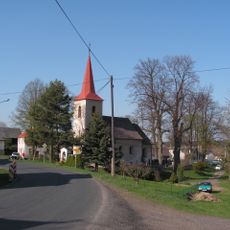
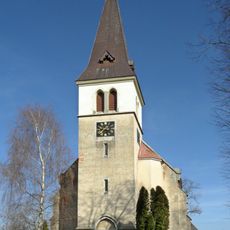
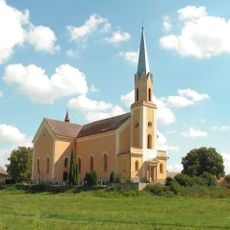
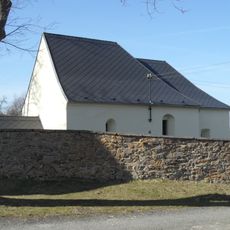
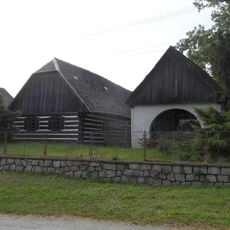
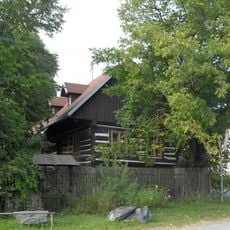
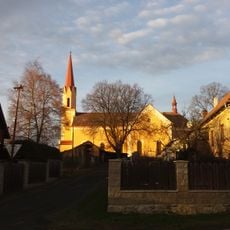
Stronghold Dobrovítov, Fortified house in Dobrovítov, Czech Republic.
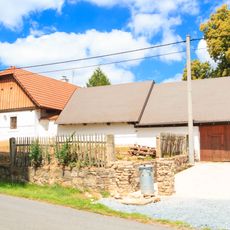
Dobrovítov is a one-storey fortified house with a T-shaped plan and a gabled roof, its modern facades plain after sgraffito fragments visible before 1962 were lost. Inside, Renaissance elements from the second half of the 16th century survive: ground-floor rooms have barrel vaults with triangular lunettes and ridges. A torso of a farm building belongs to the protected complex.
The stronghold is first documented in 1533, when Jiří Dobrovítovský z Újezda bequeathed the small estate to his grandsons Václav and Jiří Špetle. The Renaissance building was erected around that time; an older Gothic seat probably stood east of the church of St Wenceslas, where deep cellars were filled in in 1972. In 1560 Jiří Špetle sold Dobrovítov to Ernest of Bavaria, and from 1571 it belonged to the Šaratice family. Plundered several times in 1620–1627, it lost its residential role and served the adjoining farm; from 1924 it was converted into flats.
The name Dobrovítov comes from the village's founding family; Jiří Dobrovítovský z Újezda owned the estate when the fortress was first recorded in 1533. From the 17th century the building served the adjoining farmyard, and from the 1920s it was converted into flats. A deep Gothic cellar east of St Wenceslas Church, its entrance filled in 1972, marks the site of an older residence.
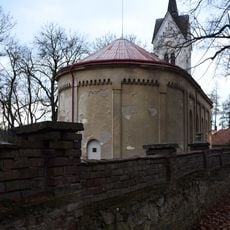
The stronghold stands in the village of Dobrovítov south of Čáslav, in the Kutná Hora district. It is a one-storey building with a T-shaped plan and a gabled roof, now used as housing, so it is seen from the outside; the grounds also hold the fragment of a farm building. The entrance to the old Gothic cellars east of the church of St Wenceslas was filled in in 1972.
The older Gothic seat probably stood east of the church of St Wenceslas, where deep Gothic cellars survive; their entrance was filled in in 1972. A 1628 inventory lists four chambers, a kitchen, a larder and a cellar, and a pond that fed the moat. Fragments of sgraffito decoration were visible on the facades until 1962.
The community of curious travelers
AroundUs brings together thousands of curated places, local tips, and hidden gems, enriched daily by 94,962 contributors worldwide.