Castle watermill, Renaissance watermill in Horažďovice, Czech Republic
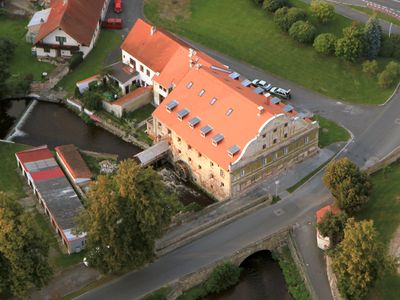
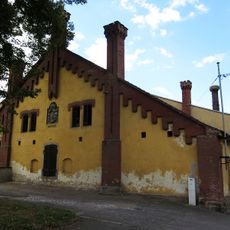
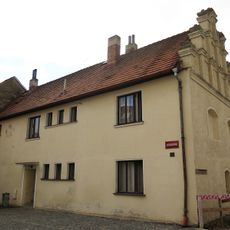
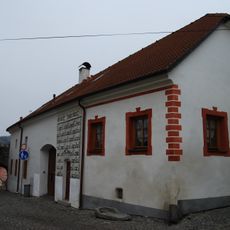
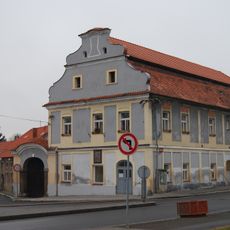
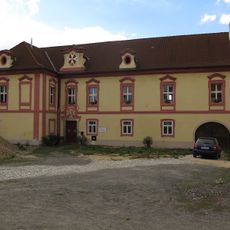
Castle Watermill is a large, two-storey watermill on a square plan in Horažďovice, standing on the Mlýnský potok, a millrace fed from the Otava. Its roof is gabled and covered with bobrovky tiles; the south and west facades are seven-axis with smooth wall surfaces, quoins and the central risazit are rusticated, and a cordon cornice separates the floors. The segmental-arched entrance portals have keystones, with conical ramps at ground level.
The mill was built during the Renaissance period, when it served to supply flour to the surrounding population. It remained an important part of the local economy and operated for several centuries.
The mill takes its Czech name, Podzámecký mlýn, from its position below the castle in Horažďovice. It stands on the Mlýnský potok, a millrace fed from the Otava, and is listed as a cultural monument of the Czech Republic. The building is now empty of milling machinery; only the water wheel survives.
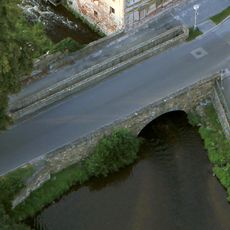
The mill stands on the Mlýnský potok, a millrace fed from the Otava River, in Horažďovice. The building is a protected cultural monument and no milling technology survives inside; only the water wheel is preserved. The millrace and wheel are best seen from outside, along the water channel.
The mill retains no milling machinery at all; only the water wheel survives, fed by a millrace drawn from the Otava. The building itself, originally Renaissance, already appears in a 1606 view of Horažďovice.
The community of curious travelers
AroundUs brings together thousands of curated places, local tips, and hidden gems, enriched daily by 93,512 contributors worldwide.