Milíčeves Castle, Château in Milíčeves, Czech Republic.
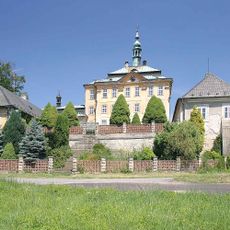
Milíčeves Castle is a manor house in Milíčeves located in the Hradec Králové Region with characteristic Czech architectural design. The structure sits within an extensive park that frames the building and provides outdoor space around it.
A 14th-century fortress of the Dohanští z Dohalic family stood here; Bedřich Bořek starší Dohalský lost the estate in 1621 for joining the Bohemian Revolt, and Albrecht z Valdštejna bought it in 1623 and gave it to the Jičín Jesuits in 1627. They built an early Baroque summer residence in 1677–1679 to plans by Carlo Luraga, using stone from the demolished Veliš Castle. After the order's dissolution in 1773 it housed officials; Michael Karel Althann had it rebuilt in Neoclassical style from 1841, and a fire struck on 17 April 1903.
The castle has housed a home for the elderly since the second half of the 1950s. Its first-floor Chapel of St. Wenceslas holds a painting made around 1850 and stucco work showing scenes from the saint's legend. The seven-hectare park, with two ponds, is open both to the home's clients and to the general public.
The castle stands in a seven-hectare park in the northwest part of Milíčeves, with two ponds; the park is open both to clients of the social services institute and to the general public. The main façade faces south, and the entrance lies in the central projection beneath a small loggia on four columns.
The castle was built with stone taken from the nearby Veliš Castle, which was being dismantled at the time, because good building stone was scarce in the area. Its central projecting bay, raised by a third storey with a clock, is counted among the earliest examples of this design, later taken up by Alliprandi and Santini.
The community of curious travelers
AroundUs brings together thousands of curated places, local tips, and hidden gems, enriched daily by 92,653 contributors worldwide.