Vodní mlýn, Watermill in Holubov, Czech Republic
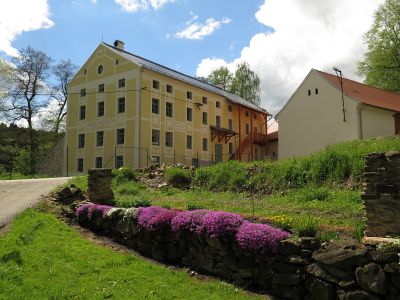
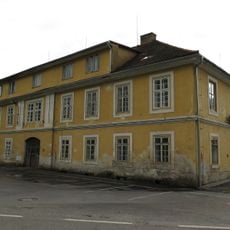
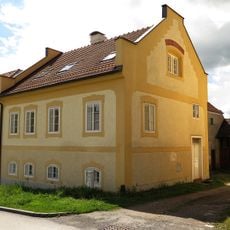
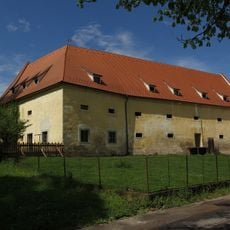
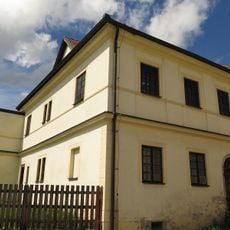
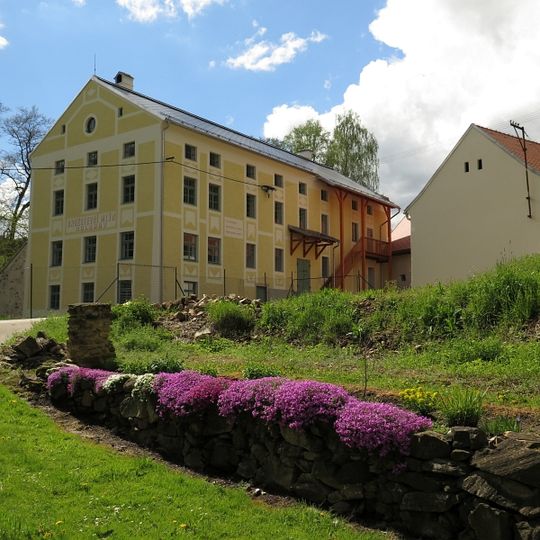
Holubovský mlýn (Krossetzer Mühle) is a watermill on the Křemžský potok northwest of Holubov, in the Český Krumlov district. Three Renaissance perimeter walls of the mill house survive, covered in psaníčkové sgrafito, while two exposed sides were given late geometric Secession façades after the 1929 rebuilding. A Francis turbine by UNION of České Budějovice, installed after 1929, remains in place and still generates electricity.
The mill is first documented in 1600 as property of the Český Krumlov estate. In 1913 a milling cooperative bought it, and in 1929 the cooperative raised the mill house by two storeys, removed most of the inner masonry and added a Francis turbine. Nationalised in 1953, it was shut down two years later and used as a grain store by the Křemže collective farm until the 1990s.
The mill's German name, Krossetzer Mühle, recalls the mixed Czech-German population of this part of Bohemia. Since 1999 it has been protected as a cultural monument of the Czech Republic, listed as a technical monument. Its later use was as a grain store for the Křemže collective farm until the 1990s.
The mill stands northwest of Holubov on the Křemžský potok, reached by the millrace that once fed its wheels. It has been a listed cultural monument since 1999 and is privately owned, so visits depend on the owner's arrangements rather than opening hours. The surviving Francis turbine and power generation equipment are indoors.
The mill's Renaissance core survives in three perimeter walls of the milling hall, covered in psaníčkové sgrafito — scratched patterns in the plaster. After the 1929 rebuilding, two exposed sides were given late geometric Secession façades. A Francis turbine made by UNION a.s. of České Budějovice, installed after 1929, is still in place.
The community of curious travelers
AroundUs brings together thousands of curated places, local tips, and hidden gems, enriched daily by 92,606 contributors worldwide.