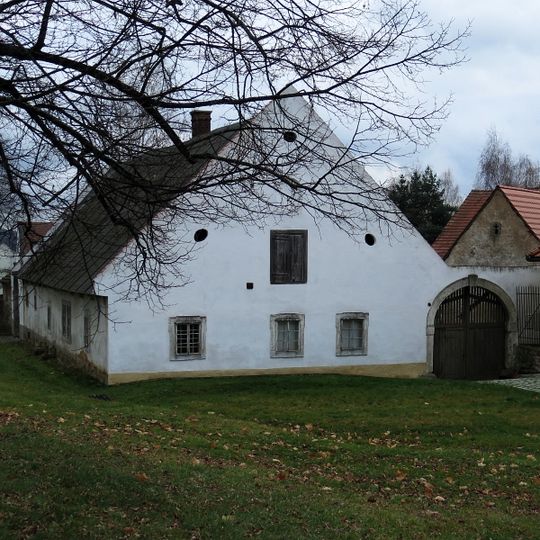
Selský dvůr, Historical homestead in Bolevec, Czech Republic.
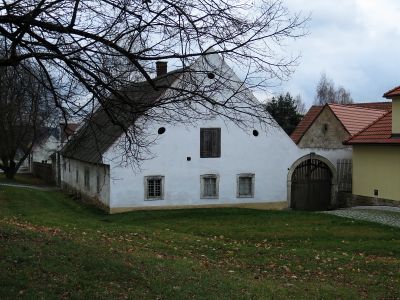
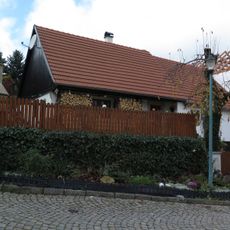
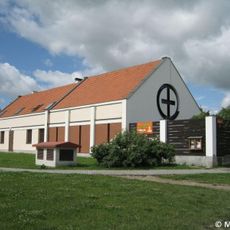
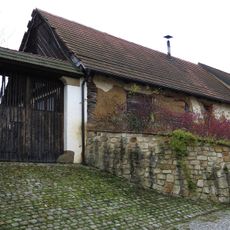
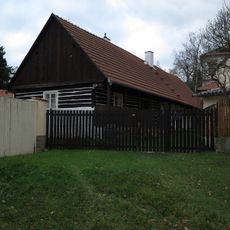
Selský dvůr is a rural farmstead in Bolevec that preserves traditional Czech building styles through its collection of structures. The property includes a main residence, barn, granary, storehouse, and stables, with exhibits now displayed in several sections to show how agricultural life was organized.
The farmstead is first documented in 1635 under the name Weysovský dvůr; the buildings themselves are older. Around 1809 the dwelling house was rebuilt in Neoclassical form, with a new granary and barn following about twenty years later; the chov and stables are documented to 1839. After 1948 a collective farm used it for piglets and as a fire-equipment store, and it decayed until the city bought it in 2004.
The farmstead's name comes from Matouš Vicl, who held it from 1635 to 1684; before that it was called Weysovský dvůr. Since June 2021 the restored buildings have housed an exhibition on rural building, architecture and village life in the 19th and 20th centuries. Look for the carved horse and cow heads above the stable entrances, marking which animals were kept inside.
The farmstead opened to visitors in early June 2021 after reconstruction that began in August 2019 and gave the residential house a new thatched roof in summer 2020. Access is through two round-arched gates: the main western gate bears the year 1834, the eastern one 1830. From 2026 the site is managed by the Museum in Rožnov pod Radhoštěm, not the National Heritage Institute.
Two late-Gothic stone portals were reused in the cellars built at the start of the 19th century, probably taken from the above-ground part of an older house. The eastern portal survives whole, though its two archivolts differ slightly in size and curvature, so it may combine two originally separate portals.
The community of curious travelers
AroundUs brings together thousands of curated places, local tips, and hidden gems, enriched daily by 93,154 contributors worldwide.