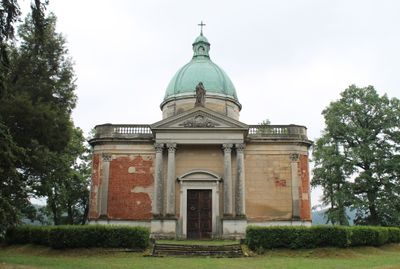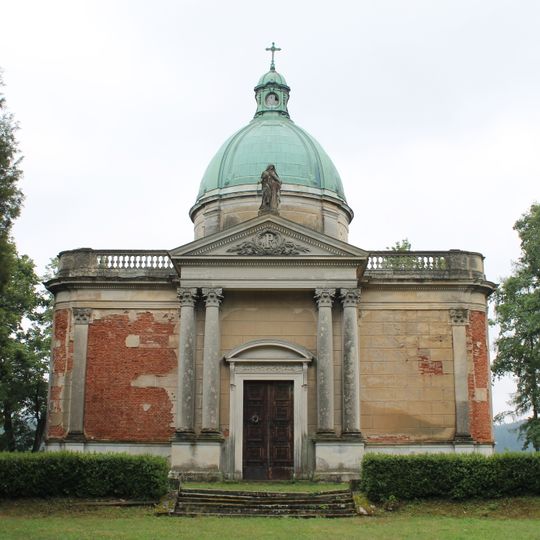
Pallavicini Vault, Family tomb in Jemnice, Czech Republic.
The Pallavicini Vault is a free-standing funeral chapel built in 1901–1902 in neo-classical style on a Greek-cross plan with rounded corners. A dome on a drum with pilasters rises over the crossing, topped by a lantern and cross. The entrance is framed by two Ionic columns and a pediment bearing the letters APX, with a life-size statue of the Virgin Mary above. The interior holds a bronze crucifix by Ignác Weirich and seven white marble sarcophagi.
The vault was built in 1901–1902 on the Jemnice estate of Marquis Alexander Oswald Pallavicini, to a design of 1900 by the Viennese court architect Otto Hofer; after Hofer's death in 1901 Wilhelm Zeeh led the work, and Jemnice craftsmen completed it in 1902. The impulse was the death of Karl Pallavicini, fatally injured in a fox hunt in England on 15 January 1900; his mother wanted the tomb visible from the chateau. The family held Jemnice from 1841/1842 to 1945.
The vault's name comes from the Pallavicini family, originally Italian nobles who owned Jemnice Castle from 1841 to 1945. The family's original burial site at Ányás in Hungary lay in the Tisza floodplain and proved unsuitable, so this mausoleum was built. Eight family members were interred here; the castle physician Josef Švejda embalmed the bodies before burial.
The site is reachable on foot from Jemnice town center and sits within landscaped grounds with walking paths around it. Visitors should know the building is undergoing restoration, so access or visibility may be limited.
The vault was looted in 1954 and again in 1991, when marble sarcophagi and zinc coffins were forced open. Since the 1990s only the body of Countess Gabriela Pallavicini remains, placed in the underground crypt. Part of the copper roof cladding was later stolen, and in August 2014 metal parts of the fence were taken.
The community of curious travelers
AroundUs brings together thousands of curated places, local tips, and hidden gems, enriched daily by 92,697 contributors worldwide.