Saint Vitus church, Early Baroque cemetery church in Týn nad Vltavou, Czech Republic
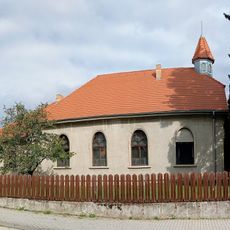
Saint Vitus Church in Týn nad Vltavou is an early Baroque cemetery church built in 1681–1682 from rough-cut stone. It has a rectangular plan with three conch-vaulted apses and two small square bell towers with tent roofs flanking a tympanum on the south facade. The nave is topped by a dome with a lantern, and the roof is covered with beaver-tail tiles.
Built in 1681–1682 by an unknown builder, possibly the Italian architect Antonio de Alfieri, as a cemetery church during the plague epidemic of 1680–1681. Funds came from the estate of citizen Kubeš, a public collection and Archbishop Jan Fridrich. The bell was recast in 1820 by Jan Perner, and repairs followed in 1863 and 1876.
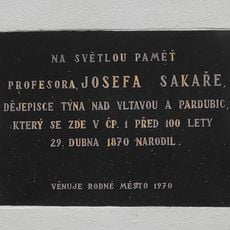
The cemetery church is linked to the plague epidemic of 1680–1681, when a new burial ground for the poor was laid out outside the town. The composer Karel Komzák st. (1823–1893) and the town historian Josef Sakař (1870–1937) lie buried here, and a 1905 monument by the church wall recalls the puppeteer Matěj Kopecký, whose remains were placed in an unmarked grave in 1847.
The church stands in the southern part of the walled cemetery, whose eastern wall runs parallel to the road II/105 toward Tábor. The old mortuary with its octagonal lantern roof sits in the southwest corner, and a modern utility building stands in the northwest. The site lies outside the town centre, so plan on a longer walk or a short drive.
The cemetery wall holds a 1905 monument to puppeteer Matěj Kopecký, whose remains were placed in an unmarked grave here in 1847. The old mortuary in the southwest corner has a brick floor concealing a crypt used by the Koloděje branch of the Vratislavs of Mirovice.
The community of curious travelers
AroundUs brings together thousands of curated places, local tips, and hidden gems, enriched daily by 94,143 contributors worldwide.