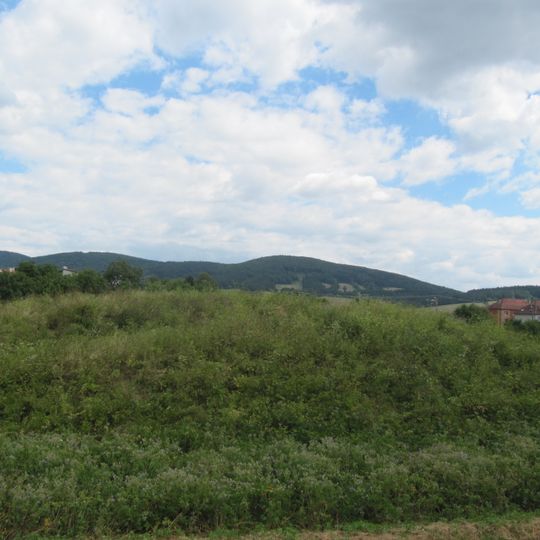
Cultural monuments in Vlachovice, Fortified house in Vlachovice, Czech Republic
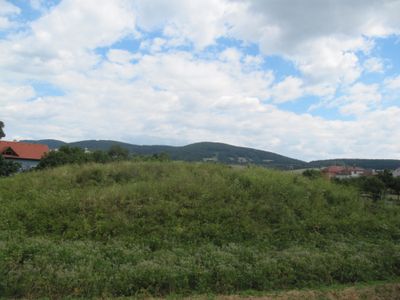
The Vodní tvrz Kaštýl in Vlachovice survives only as an archaeological site: a grass-covered mound about 32 x 25 m rising 3.5 to 5 m above the land, with no traces of masonry. A partly preserved perimeter rampart and a well-preserved circular moat, once fed by the nearby Vlára, enclose a roughly rectangular area of about 80 x 65 m.
The water fortress Kaštýl was built around 1460 by the Vlachovští z Vlachovic family, who had held the village since 1343. In 1544 they sold it to the Podstatští z Prusinovic to pay debts; by 1574 it was split between the Jakušic and Aranyi families, and in 1593 Dorota Jakušičová's half passed to the Serényi through her marriage. Austrian dragoons used the already abandoned fortress in 1703–1709 against Rákoczi's kuruc rebels, and from the early 18th century locals quarried it for building stone.
The name Kaštýl, used for the site, comes from the fortified residence the Vlachovští lords built here around 1460. The moat was fed by water from the nearby Vlára, and the oval rampart and ditch are still readable in the meadow. The site is now an archaeological trace with no standing masonry.
The remains lie on the southwestern edge of Vlachovice, near the road to Vrbětice and about 50 m from the right bank of the Vlára. There is no masonry to see: only a grass-covered mound about 32 x 25 m, rising 3.5 to 5 m, ringed by a partly preserved rampart and a well-preserved circular moat once fed by the river.
The moat was fed by water from the nearby Vlára River, and it survives as the best-preserved element of the site. The core mound, about 32 × 25 m and rising 3.5–5 m, now carries no traces of masonry. Austrian dragoons used the already abandoned fortress in 1703–1709 against Rákóczi's kuruc rebels.
The community of curious travelers
AroundUs brings together thousands of curated places, local tips, and hidden gems, enriched daily by 94,337 contributors worldwide.