Church of the Assumption of the Virgin Mary, Baroque-rebuilt church in Třebsko, Czech Republic
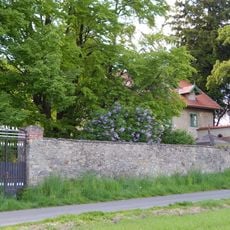
The Church of the Assumption of the Virgin Mary is a single-nave church with a likely Romanesque core from the first half of the 13th century, rebuilt in Baroque style in the 17th century. It stands on a hill at the southern edge of Třebsko, within a walled early Baroque cemetery with two gates. Three crosses stand nearby: a cast-iron cross from 1879 before the western gate, a wrought-iron cross behind the presbytery, and a stone cross from 1849 by the access road.
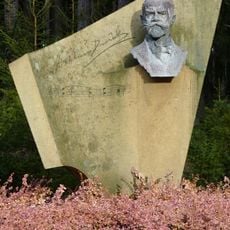
The church has a Romanesque or early Gothic core, first documented in 1352, and was rebuilt in Baroque style in the 17th century. On 26 July 1790 the composer Jakub Jan Ryba married Anna Laglerová here. Antonín Dvořák, who summered nearby at Villa Rusalka in Vysoká u Příbramě, often played the organ and bought a new instrument in 1894 with money from his first US tour. Lightning struck the church in 1953; the fire left only the outer walls, and it was restored in 1957.
The church is linked to a legend of a hermit who lived on Zavírka hill past the age of one hundred; when he died, the bells of Třebsko rang by themselves, and a team of oxen with a cart went to the place of his death as a sign that he wished to be buried in the churchyard. The site of the hermitage may have been in the woods between Skelná Huť and the Pilská reservoir, where traces of a building dated by archaeological survey to roughly the 15th century were found; alternatively, it may have been a royal gamekeeper's lodge mentioned in sources from the second half of the 16th century, where the gamekeeper Václav lived. The solitary gamekeeper could have become the basis for the legend of the hermit.
The church is best reached on foot and can be viewed from outside, with information available through regional historic sites management. For interior visits or access during ceremonies, check locally or arrange in advance.
The organ now in the church comes from the workshop of Gotthard Weltzl in Králíky, donated by the Pelherter family and moved here from the cemetery chapel of St. Anne in Klášterec nad Ohří. Its acanthus carvings and painted pipes with mask motifs are said to have no equal in Bohemia, and it is the only instrument Weltzl signed.
The community of curious travelers
AroundUs brings together thousands of curated places, local tips, and hidden gems, enriched daily by 92,869 contributors worldwide.