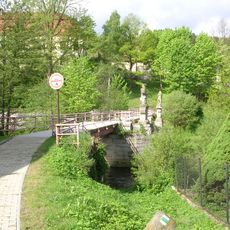
Weir in Vyšší Brod, Historic weir in Vyšší Brod, Czech Republic.
The weir in Vyšší Brod spans the Vltava River using stone and wooden elements to manage water flow and regulate river levels. The structure creates distinct water conditions on either side, shaping how the river behaves in this location.
The oldest date preserved on the structure is 1675. The weir was built to raise water for the adjoining Bílý mlýn (White Mill, house no. 11) and its millrace. It is the last Vltava weir to retain a raft passage (vorová propust) and its original construction. The last raft through it, nearly 80 m long and built for Czechoslovak Television, sailed from Vyšší Brod to Branná on 20 April 1966.
The weir demonstrates traditional Czech approaches to managing water flow and landscape. Walking along the bank, you can observe how the structure has been part of daily river life for centuries.
You can view the weir from riverbank paths and nearby bridges that run along the Vltava. Kayakers and paddlers use the designated passage, with summer being the best time for water activities in this area.
The last raft to pass through the chute at Bílý mlýn was a nearly 80-metre vessel built for Czechoslovak Television. It sailed from Vyšší Brod to Branná on 20 April 1966, and both its construction and the voyage appear in episode 12 of the Czech Television series Hledání ztraceného času.
The community of curious travelers
AroundUs brings together thousands of curated places, local tips, and hidden gems, enriched daily by 94,022 contributors worldwide.