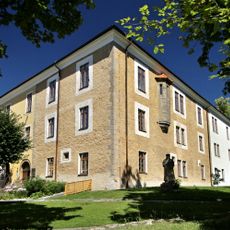
Dědičná štola císaře Josefa II., Main drainage adit in Trhové Dušníky, Czech Republic.
The Dědičná štola císaře Josefa II. is a drainage adit driven through rock and partly vaulted with stone masonry, running from the Štěpánka shaft near Bohutín northeast through Vysoká Pec, Drkolnov and Březové Hory to its outlet near Trhové Dušníky. Its total length with all branches is 21,906 m; the main adit is 14,854 m long and follows ore veins, with 8,944 m also driven as a crosscut. The protected section runs from the Ševčiny mine to the outlet.
The adit was begun around 1789 to drain water from the silver and lead mines of the Březové Hory, Příbram and Bohutín districts, following a drainage concept drafted by mining official Ignác Anton Putz in 1693. The final breakthrough between the František and Řimbaba mines came on 8 July 1859. The Zdabořská shaft was connected in 1862, and the adit was protected as a cultural monument in 1973.
The adit is named after Emperor Joseph II, who ruled the Habsburg lands when excavation began around 1789. Its Czech name, dědičná štola, marks it as a hereditary gallery, a tunnel whose maintenance was funded in perpetuity from mining revenues. The protected section runs from the Ševčiny shaft to the outlet near Trhové Dušníky.
The adit follows the ore veins at the level of the second mine floor, 57 to 101 metres below the surface, with a gradient of 3 to 5 per mille. The protected section runs from the Ševčiny shaft to the outlet near Trhové Dušníky, where the portal was repaired in 2018–2019 and fitted with a two-leaf metal grille.
Water still flows through the tunnel today and is channeled by the system into the Litavka River. This ongoing drainage demonstrates how effective the original engineering was and how it continues to serve its purpose after centuries.
The community of curious travelers
AroundUs brings together thousands of curated places, local tips, and hidden gems, enriched daily by 93,790 contributors worldwide.