Manský dvůr, Timber-framed former estate in Dolní Žandov, Czech Republic
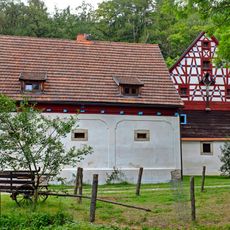
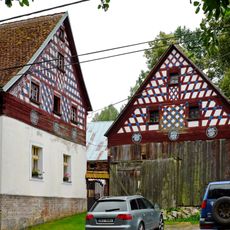
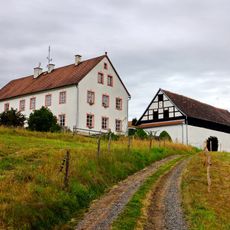
Manský dvůr is a hamlet of timber-framed buildings from a former estate 2 km from Dolní Žandov, in a shallow basin at the foot of the Slavkovský les. The grounds cover over 300 hectares of meadows, ponds and forests, with the wooded hill Skaliska (546 m) rising above. The farm buildings, with painted illusory half-timbering on the gable, stand beside a modernist villa designed by architect Milan Babuška in the 1930s.
Manský dvůr was first recorded in writing in 1242, when a guard post on the site was later turned into a fief, hence the German name Lehnhof. Before World War I it belonged to the Kynžvart manor, and the 1919 land reform made it a residual estate. In the early 1930s the Prague architect Milan Babuška bought the run-down farm and added land; after the 1938 annexation Konrad Henlein took it as a summer residence. Nationalised in 1948, it returned to the Babuška family after 1989 and was reconstructed.
The museum opened in 2003 in a reconstructed building and holds hundreds of exhibits, mainly on the history of the Mariánské Lázně region. The items come from the private collections of the regional historian and publicist Zdeněk Buchtele (2 June 1950 – 4 July 2021).
The property is best explored on foot, with its guest areas and surrounding grounds laid out in a compact way that makes walking comfortable. Visitors should come prepared for changing weather and wear sturdy footwear, especially if planning to walk the meadow paths and forest trails nearby.
The ponds below the estate were built in the 1930s on the design of ichthyologist Schaferna, after the Babuška family bought the run-down farm. A painted illusion of timber framing on the gable of the farm building is easy to miss.
The community of curious travelers
AroundUs brings together thousands of curated places, local tips, and hidden gems, enriched daily by 92,594 contributors worldwide.