Bořeň, Extinct volcano near Bílina, Czech Republic
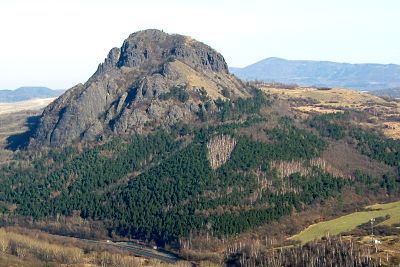
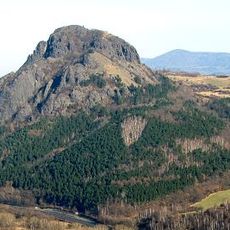
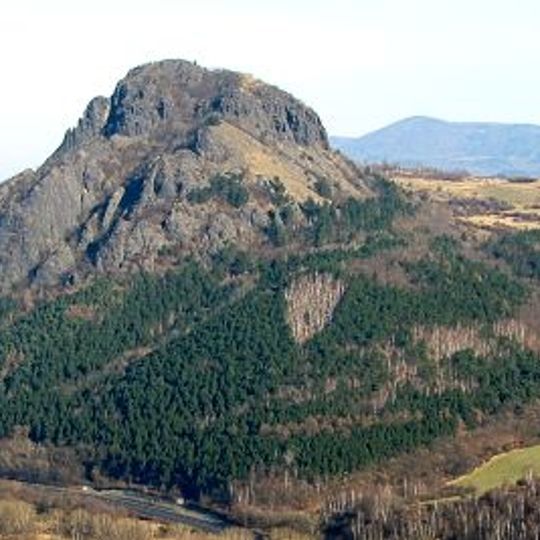
Bořeň is a phonolite rock hill south of Bílina, its summit at 539 m. Its steep, fissured walls reach up to 100 m and give it the profile of a lying lion, hence the name Biliner Löwe. The hill is the largest phonolite monolith in Central Europe.
The phonolite laccolith intruded into Cretaceous marl layers during Tertiary neovolcanic activity, then frost weathering and erosion exposed it as a rock suk. Archaeological finds from the Únětice and Knovíz cultures come from the hill, and a prehistoric settlement stood on the southwestern shoulder at 330–365 m. The site was first protected in 1946 and declared a national nature reserve in 1977, enlarged to 65.37 ha in 2013.
The mountain's shape resembles a lying lion, which gave rise to the name Biliner Löwe (Bílina Lion). Johann Wolfgang von Goethe visited the Borschen during his volcanological studies and drew it several times. The climbing pioneers Gregor and Berthold of the Žatec Alpine Club are remembered in the rock formations Bertholdův prst and Řehořův komín.
A green-marked circular trail leads from Bílina over the mountain, with a branch path to the summit; the student nature trail built in 1999 runs from the Chata pod Bořeňem to the top, its A3 panels renewed by the Bílinská přírodovědná společnost. The summit gives a circular view in all directions, over the Most–Bílina–Duchcov lignite quarries to the north and the peaks Hradišťany, Milá, Raná and Oblík to the east and south.
On 20 July 2019, a group of artists built a one-metre cairn on the summit, raising the official height to 540 metres and fixing a metal plate with the new figure. The gesture marked the 50th anniversary of the Moon landing. The hill is often compared to Devils Tower in Wyoming for its phonolite rock and similar setting.
The community of curious travelers
AroundUs brings together thousands of curated places, local tips, and hidden gems, enriched daily by 92,632 contributors worldwide.