Vila Hermína, Villa in Černín, Czech Republic
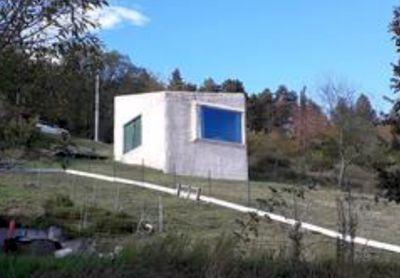
Vila Hermína is a contemporary villa on the outskirts of Cerníň built on sloping ground and characterized by alternating level and inclined floor surfaces throughout its interior. The entire structure is insulated with pink polyurethane spray, and each wall contains precisely one opening.
The villa was designed by architects Petr Hájek, Tomáš Hradečný, and Jan Šépka between 2000 and 2009 following extensive planning phases. This project emerged during a period when experimental residential architecture gained increasing recognition in Czech Republic.
The villa represents a contemporary approach to domestic architecture that stands apart from conventional building styles found in the surrounding area. Visitors immediately notice the unconventional design with its sloping surfaces and sparse wall openings, setting it distinctly apart from nearby residences.
Vila Hermína is a private family residence, not open to the public, so it can only be viewed from the road on the edge of Černín. The house stands on sloping ground; the northern wall with the entrance has no window, while each of the other three walls holds a single large frameless window. The pink coating is renewed roughly every ten years and need not stay pink.
The pink colour of the polyurethane facade was inspired by German architect Ludwig Leo's paintwork on the water-supply pipe of Berlin's Institute for Water Construction. The house has no gutters, so rainwater runs freely down the walls, and the coating must be renewed roughly every ten years.
The community of curious travelers
AroundUs brings together thousands of curated places, local tips, and hidden gems, enriched daily by 94,497 contributors worldwide.