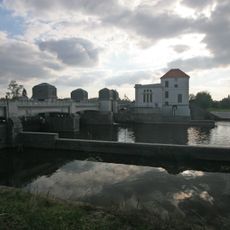
Semín aqueduct, Concrete aqueduct in Semín, Czech Republic.
The Semín aqueduct is a concrete structure in the Semín area of the Pardubice region, measuring 13.5 meters long and 7 meters wide. It functioned as part of a water distribution system that carried water across the landscape.
The aqueduct was built between 1783 and 1787, when a weir at Opatovice led to the rerouting of the Opatovice Canal from the Výrov mill in Břehy to its present outlet. The canal itself had been dug between 1498 and 1521 under Kunát Dobřenský z Dobřenic, fish master of the Pernštejn family. The original aqueduct was made of timber beams sealed with clay; it was rebuilt in concrete and repaired during the canal's overall reconstruction in 2003.
The aqueduct is a level crossing of two waterways: the Opatovice Canal, built 1498–1521 under the Pernštejn fish master Kunát Dobřenský z Dobřenic, passes about two metres above the Sopřečský stream at river kilometre 29.4. The original structure was timber beams sealed with clay; the concrete version was repaired in 2003, when an overflow was added to divert surplus canal water into the stream and reduce flood risk for Semín.
The aqueduct stands at river kilometre 29.4 of the Opatovice Canal, about two metres above the Sopřečský Stream near Semín. Since the 2003 renovation a spillway carries surplus canal water into the stream, lowering the flood risk for the village. The structure is 13.5 m long and 7 m wide.
The original aqueduct was built of wooden beams sealed with clay; the concrete structure seen today dates from the 2003 reconstruction of the Opatovice canal. That work also added a spillway that diverts surplus canal water into the Sopřečský stream, lowering the risk of flooding in Semín.
The community of curious travelers
AroundUs brings together thousands of curated places, local tips, and hidden gems, enriched daily by 92,647 contributors worldwide.