Ústecká hvězdárna, Astronomical observatory in Telnice, Czech Republic
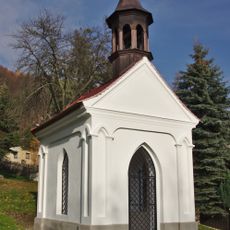
Ústecká hvězdárna is an astronomical observatory in Telnice, a small village near Ústí nad Labem in the Czech Republic. It sits on a south-facing hillside at around 480 meters elevation, and its compact stone building is topped with a rotating dome designed to house a telescope.
The Association of Friends of the Observatory of the German University in Prague bought a 2,800 m² plot at 480 m on the southern slope of the Ore Mountains in spring 1929 and built the sandstone observatory that same year, designed by František Eise of Ústí nad Labem and built by Richard Wagner of Varvažov. In 1931 instruments arrived from the dissolved Clementinum observatory in Prague, including a 160 mm Steinheil telescope. During the Second World War the German mining academy in Duchov used the site to measure the Earth's magnetic field for mine surveying.
The observatory's measuring instrument, a lens of 6.8 cm giving 74-fold magnification, had travelled with the Austrian polar expedition to the island of Jan Mayen in the Greenland Sea from June 1882 to August 1883 before it was installed here. The first observers were Dr. Josef Mrázek and Dr. Rudolf Tschilschke; Mrázek moved to Telnice and managed the site from 1924 to 1945.
The building stands on a south-facing slope at 480 m above sea level in Liboňov, about 40 m south of the meteorological measuring equipment and with a small cellar 40 m to the north. Restoration by Vít Musílek began in 2022 and is ongoing, so the interior may not be accessible. The sandstone structure is 9 m long and 5 m wide, with an entrance on the east side.
The original roof of the building was fully retractable, meaning it could slide open to expose the entire sky above, not just a narrow slit as in most domes. This allowed observers to track objects across the whole sky without repositioning the structure.
The community of curious travelers
AroundUs brings together thousands of curated places, local tips, and hidden gems, enriched daily by 94,023 contributors worldwide.