Fort Saulsbury, Coastal defense fort in Slaughter Beach, Delaware, United States
Fort Saulsbury is a coastal defense installation featuring two batteries positioned along the Delaware shoreline and originally equipped with heavy artillery guns. The structure consists of concrete gun emplacements and bunkers oriented toward the ocean.
Construction of Fort Saulsbury's two-gun batteries, Hall and Haslet, began in 1917 using the M1917 high-angle barbette carriage, which raised the range of the 12-inch M1895 gun to 30,100 yards. The batteries were completed in 1920 but accepted for service in 1924, and the fort served as the primary heavy gun defense of the Harbor Defenses of the Delaware until 1943. That year Battery Haslet's guns went to Fort Miles, and in 1946 the remaining guns were scrapped; the fort was sold to a private owner in 1948.
The fort is named for Willard Saulsbury Sr., a former US Senator from Delaware. Its two batteries carry the names of Revolutionary War officers: Battery Hall for David Hall, a former Governor of Delaware, and Battery Haslet for John Haslet, killed at the Battle of Princeton. The site is privately owned, so the names are not open to visitors.
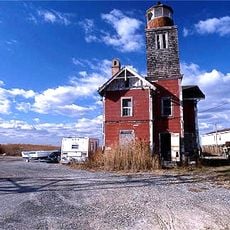
Fort Saulsbury is privately owned and has no public access; the batteries cannot be entered. The site lies near Slaughter Beach and Milford, inland from the Delaware Bay shore. The only related structure open to view is the surviving fire control tower at Big Stone Beach, which can be seen from the outside.
Fort Saulsbury is the best-preserved battery of its type in its original state: unlike most long-range 12-inch batteries, which were enclosed in heavy concrete casemates during World War II, its guns stayed in the open. The fort also held German and Italian prisoners of war during the war.
The community of curious travelers
AroundUs brings together thousands of curated places, local tips, and hidden gems, enriched daily by 94,396 contributors worldwide.