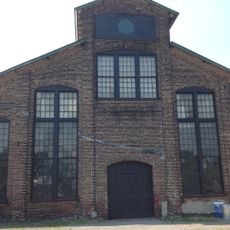
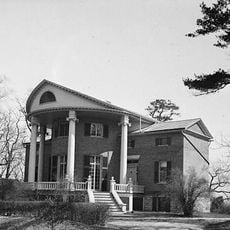
Hudson Almshouse, Federal architecture poorhouse in Hudson, United States.
The Hudson Almshouse is a dressed-limestone building of a three-story central section with two-story flanking wings, built about 1818 with a substantial rear addition from about 1884 to 1889. It stands in Hudson, Columbia County, New York, and was listed on the National Register of Historic Places in 2008.
The building was constructed in 1818 under the supervision of Dr. John Talman, Judah Paddock, and Barnabus Waterman as an almshouse for Hudson's poor population. It later served different purposes, including as a facility for mental health treatment beginning in 1830.
The building later served as the Hudson Female Academy, a school for young women. The painter Henry Ary, known for portraits and Hudson River views, taught there. The academy drew pupils from outside Hudson, making the former almshouse a regional school before it returned to other uses.
The building is located on State Street in Hudson and can be viewed from the outside, where its Federal-style architecture is clearly visible. Visitors can explore the exterior and structure of this historic building while walking through downtown.
Dr. Samuel White established a mental health facility in the building starting in 1830, notable for its reform-oriented approach to patient care. This focus on humane treatment methods was surprisingly progressive for medical practice at the time.
The community of curious travelers
AroundUs brings together thousands of curated places, local tips, and hidden gems, enriched daily by 93,330 contributors worldwide.