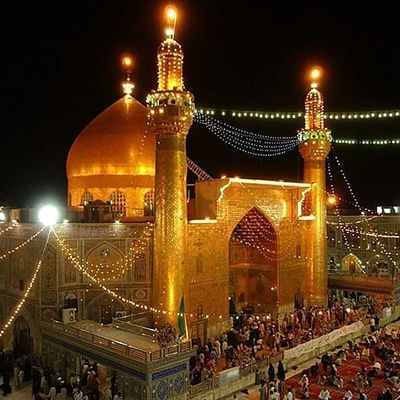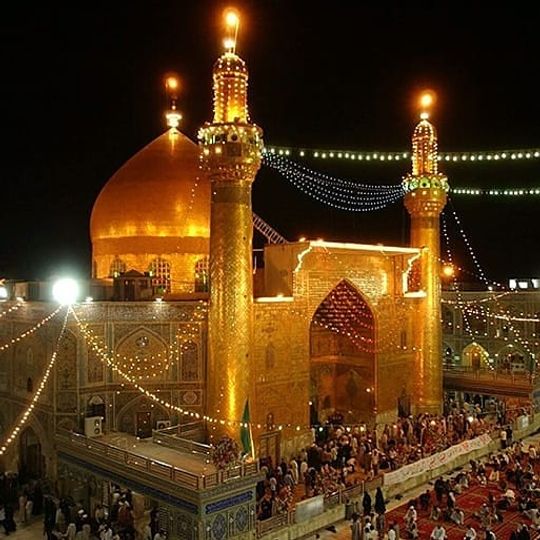
Imam Ali Mosque, Religious shrine in Najaf Old Town, Iraq
The Imam Ali Mosque is a shrine and mausoleum in the Old Town of Najaf, Iraq, marked by its domed structure and two minarets. The inner courtyards with marble floors surround the central shrine, which is enclosed by a gold-clad facade and latticed walls.
Ali was buried secretly outside Kufa in 661 CE, and the grave stayed hidden for over a century until it became public under Harun al-Rashid, who commissioned the first shrine around 786 CE. Adud al-Dawla rebuilt it grandly in the late 10th century and founded Najaf; a fire damaged it in 1354 CE, and in 1743 Nader Shah gilded the dome and twin minarets.
Each year millions of Shia pilgrims come to Najaf to pay tribute at Ali's tomb, the holiest Shia site after Mecca, Medina and Jerusalem. Ibn Battuta, visiting in 1327, described a large adjoining school where every newly arrived traveller was hosted for three days and given bread, meat and dates twice daily.
Visitors should wear modest clothing and remove shoes before entering the interior spaces. The complex is accessible during daytime hours and best avoided during prayer times when particularly many people are present.
A decorative panel once stood beneath an arch near the tomb, showing a hunter with a bow pursuing a gazelle; it recalled Harun al-Rashid's hunt, when his dogs halted at the spot and led to the grave's identification. The panel was removed in 1944–45 and taken to the shrine's treasury.
The community of curious travelers
AroundUs brings together thousands of curated places, local tips, and hidden gems, enriched daily by 92,544 contributors worldwide.