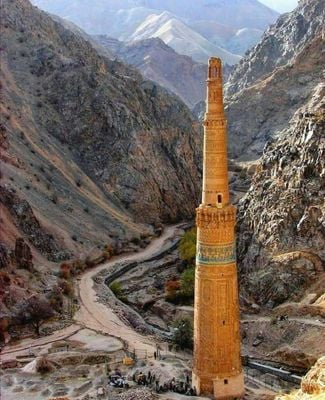
Minaret of Jam, 12th-century Islamic minaret in Ghor Province, Afghanistan.
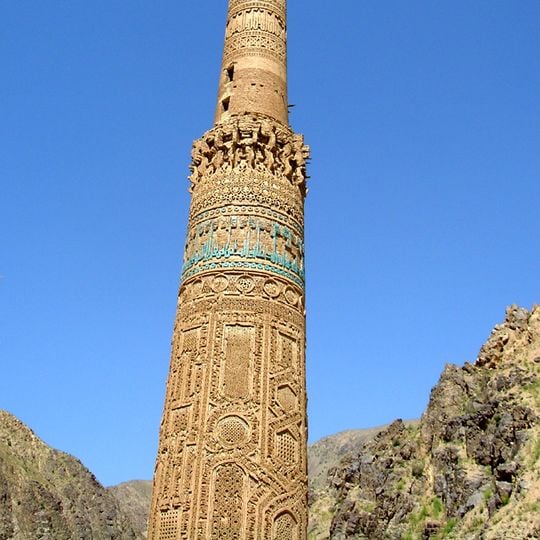
The Minaret of Jam is a brick tower in Shahrak District of Ghor Province that rises 65 meters (213 feet) above a narrow river valley. The octagonal base supports a cylindrical shaft with four superimposed bands of geometric patterns and Quranic inscriptions.
The Ghurid Empire built the tower around 1194 near their summer residence of Firuzkuh, while they controlled large parts of Central Asia. The Mongols destroyed the surrounding city in the 13th century, but the minaret remained standing.
The minaret's name comes from Jam, the village and river valley where it stands at the confluence of the Jam and Hari Rivers. Its eastern face carries angular Kufic inscriptions, except for the cursive signature of the architect, Ahmad ibn Ibrahim al-Naysaburi. A band of turquoise glazed tiles runs around the middle of the shaft, below the projecting brickwork.
The site sits at 1,900 meters (6,234 feet) elevation in a remote mountain valley accessible only by unpaved roads from Herat. Visitors should plan the journey with local guides and be prepared for changing weather conditions.
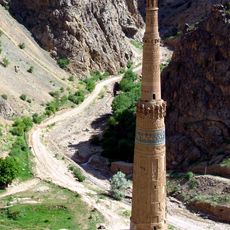
The Hari Rud has gradually eroded its southern bank and shifted its bed toward the tower; a 1971 survey found the minaret leaning about 2 degrees north, toward the river. Floods in the rainy season raise the water and multiply the risk, and the site has been on the World Heritage in Danger list since 2002.
The community of curious travelers
AroundUs brings together thousands of curated places, local tips, and hidden gems, enriched daily by 92,748 contributors worldwide.