Earth Science Museum, Natural history museum in Urca, Rio de Janeiro, Brazil
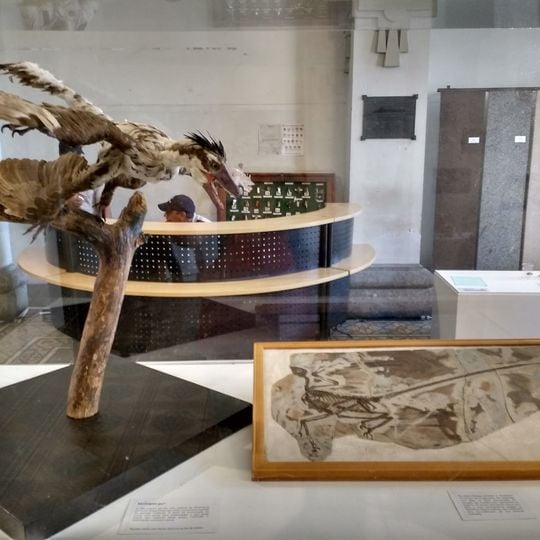
The Earth Sciences Museum (MCTer) occupies the late-neoclassical States Pavilion, built for the 1908 National Exposition marking the centenary of the opening of Brazil's ports. Its galleries hold over 100,000 items, among them roughly 7,000 mineral fragments, 12,000 meteorites, rocks, documents and fossils, plus a library of more than 100,000 geoscience titles. Its main attraction today is the collection of Brazilian dinosaur fossils.
The building was erected for the 1908 National Exposition marking the centenary of the opening of Brazil's ports, where it served as the States Pavilion. In 1909 the Geological and Mineralogical Service of Brazil moved in. The museum's name dates from 1992, when the Ministry of Mines and Energy applied it to the DNPM collections. The Rio heritage institute listed the building in 1994.
The museum is nicknamed MCTer or Palácio da Geologia. Its collection comes from specimens gathered since 1907 by the Geological and Mineralogical Service of Brazil, and its main attraction today is the fossils of Brazilian dinosaurs. A children's library holds part of the more than 100,000 geoscience titles.
The museum occupies the former States Pavilion at Avenida Pasteur 404 in Urca, under the administration of the Geological Survey of Brazil (CPRM). The building was listed as a heritage site by the Rio de Janeiro municipal government on 11 October 1994. Visitors should check current opening arrangements with CPRM before planning a visit, as access is not continuous throughout the week.
The museum's collection includes around 12,000 meteorites, rocks, documents and fossils, alongside some 7,000 mineral fragments from Brazil and abroad. Its library holds more than 100,000 geoscience titles, and a children's library is part of the building. The museum is nicknamed MCTer or Palácio da Geologia.
The community of curious travelers
AroundUs brings together thousands of curated places, local tips, and hidden gems, enriched daily by 93,640 contributors worldwide.