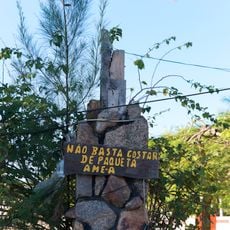
Morro do Castelo, Summit in Rio de Janeiro, Brazil.
Morro do Castelo was a hill in the centre of Rio de Janeiro, demolished in 1922. It stood where the Castelo district and the area around Avenida Rio Branco now lie, and its earth was used to fill parts of Urca, the Rodrigo de Freitas Lagoon and the Jardim Botânico. No trace of the hill remains.
The city founded by Estácio de Sá in 1565 at the foot of Morro Cara de Cão was moved to this hill in 1567, after the French were expelled under Mem de Sá. A walled citadel with the São Tiago fortim, a Sant'Ana battery and the São Januário fortress gave the hill its successive names. It held the first Câmara and jail, the governor's house and the Jesuit college. The hill was demolished in 1922 by mayor Carlos Sampaio.
The hill's name changed with its fortifications: São Tiago, São Januário, São Sebastião, and finally Castelo. Its slopes held the first Casa da Câmara and Cadeia, the governor's house, and the Jesuit college, later the Court Military Hospital and the National Observatory. The stone marker of the city's founding and Estácio de Sá's remains, once kept by the first cathedral here, are now in the Church of São Sebastião dos Capuchinhos in Tijuca.
The hill no longer exists: it was demolished in 1922, so there is no slope to climb. Its earth was used to fill part of Urca, the Rodrigo de Freitas lagoon, the Jardim Botânico and other low areas around Guanabara Bay. The flat ground left behind is today's Castelo area in central Rio, near Avenida Rio Branco.
The legend of a Jesuit treasure hidden in tunnels beneath the hill gained force after the order was expelled from Brazil in 1759. In 1905, during works for Avenida Central, a tunnel was found; a treasure inventory later claimed 67 tonnes of gold and a life-size image of Saint Ignatius of Loyola with diamond eyes and pearl teeth. The hill itself was demolished in 1922.
The community of curious travelers
AroundUs brings together thousands of curated places, local tips, and hidden gems, enriched daily by 93,009 contributors worldwide.