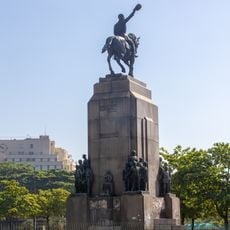
Monument to the dead of World War II, War memorial in Flamengo Park, Rio de Janeiro, Brazil.
The Monumento Nacional aos Mortos da Segunda Guerra Mundial, known as Monumento aos Pracinhas, stands in Flamengo Park on Guanabara Bay. Its 31-metre exposed-concrete portal, the first use of raw concrete in Brazil, rises above a below-grade mausoleum where marble tablets line long low stone peninsulas. A 70 by 12 metre glass-bottomed fountain pool above the mausoleum lights and cools the interior, and an adjacent hall holds exhibits on Brazil's role in Italy.
Marshal Mascarenhas de Moraes, commander of the Brazilian Expeditionary Force, proposed the monument to receive soldiers killed in Italy. Architects Marcos Konder Netto and Hélio Ribas Marinho won the national competition, with structural design by Joaquim Cardozo. Work began on 24 June 1957 and was completed on 24 June 1959. In 1960 a commission led by Marshal Oswaldo Cordeiro de Farias exhumed 462 bodies from the Brazilian cemetery in Pistoia, Italy; the remains arrived in Rio de Janeiro on 15 December 1960.
The monument is known as Monumento aos Pracinhas, after the Brazilian Expeditionary Force soldiers it honours. Its artworks include a granite sculpture by Alfredo Ceschiatti for the three armed forces, a metal sculpture by Júlio Catelli Filho for the Air Force, and a 1959 tile mural by Anísio Medeiros for those lost at sea. Each 8 May, Victory Day, civilians and military personnel receive the Medalha da Vitória.
The mausoleum and museum sit below the 31-metre concrete portal, reached from Flamengo Park along Guanabara Bay. The Changing of the Guard falls on the first Sunday of June, August and October at 10:00, and on the first Friday of other months. The glass-bottomed fountain pool, 70 by 12 metres, lies above the mausoleum.
The Monumental Portal, a 31-metre abstract concrete sculpture, was the first use of exposed concrete in Brazil. Beneath it lies the Tomb of the Unknown Soldier: an unidentified urn was handed by Marshal Mascarenhas de Moraes to President Juscelino Kubitschek, who placed it at the portal's base, where it remains.
The community of curious travelers
AroundUs brings together thousands of curated places, local tips, and hidden gems, enriched daily by 92,807 contributors worldwide.