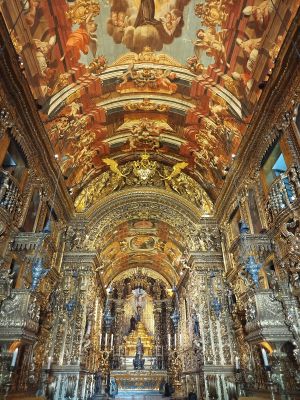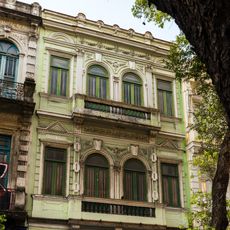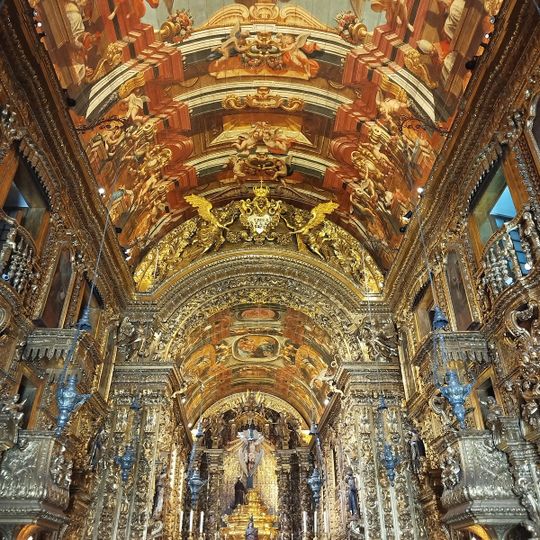
Convent of Santo Antônio, Colonial Franciscan monastery on Santo Antônio Hill, Rio de Janeiro, Brazil.
The Convent of Santo Antônio is a colonial Franciscan building on Santo Antônio Hill with a rectangular church featuring a single nave. The interior is marked by gilded woodwork adorning the main chapel and side altars.
Franciscans arrived in Rio de Janeiro in 1592 and settled near Praia de Santa Luzia. Granted the hill in 1607, they began the convent on 4 June 1608 to a design by Frei Francisco dos Santos; the first Mass was said on 7 February 1615 and the complex was finished in 1620. A second storey was added between 1748 and 1780.
The name honours Saint Anthony, whose image stands in a niche at the 1779-1781 entrance portaria. In the sub-choir near the church door are busts of the Eighteen Martyrs of Japan, Franciscans crucified in the 17th century. Two 17th-century terracotta groups show the birth and death of Saint Francis of Assisi.
The convent stands at the top of Morro de Santo Antônio, facing Largo da Carioca in the city centre. The entrance, built between 1779 and 1781, has a niche with a statue of Santo Antônio, and a stone bell frame with three bells stands beside the church door. The convent has no bell tower. The square cloister inside is still used by the friars.
The sacristy, built around 1714, holds a jacaranda chest carved and signed by the Portuguese Manuel Alves Setúbal in 1745, and a table of the same wood on which the declaration read by Prince Regent Dom Pedro on 9 January 1822 was written.
The community of curious travelers
AroundUs brings together thousands of curated places, local tips, and hidden gems, enriched daily by 92,852 contributors worldwide.