Palácio Anchieta, Government palace in Cidade Alta district, Vitoria, Brazil.
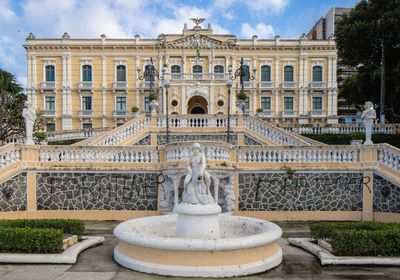
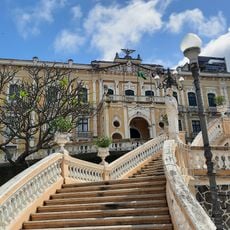
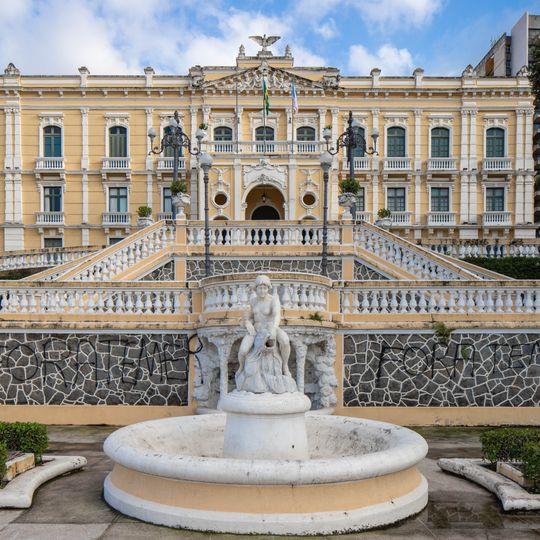
The Palácio Anchieta is a long, symmetrical yellow building of three storeys topped by a central pediment with a sculpted eagle. Pale pilasters divide the facade, whose rectangular windows have white frames and dark panes; the ground-floor windows are shuttered. A white balustraded balcony projects above an arched entrance flanked by columns and topped with three flags, and a wide double staircase with white balusters descends toward the viewer. A white fountain with a seated female figure stands in front.
The Jesuits began the complex in 1551 under Father Afonso Brás; a fire destroyed the first Church of St. James in 1570, and a stone replacement rose on the same spot. After the Jesuits were expelled in 1757 the property passed to the crown, and only in 1798, two years after a fire ruined the church interior, was the building recovered and renamed the Government Palace.
The palace is linked to Father José de Anchieta, a Jesuit whose work shaped the region's early history and remains present in its rooms today. Visitors walking through the halls can sense this historical connection and learn about the early education efforts and interactions between Europeans and indigenous peoples.
Visitors can find the building at Praça João Climaco in the city center, where it is easily accessible on foot and provides access to the main attractions of Cidade Alta. The rooms are prepared for touring, so checking current visiting times beforehand is wise.
The palace holds a piece of the tibia of Saint José de Anchieta, kept as a relic, and during renovation work bodies, probably of nobles, were found on the grounds. It is the only Jesuit construction of the colonial period that had two bell towers and a clock, and one of four buildings in Brazil using the sgraffito technique, a 16th-century Moorish method.
The community of curious travelers
AroundUs brings together thousands of curated places, local tips, and hidden gems, enriched daily by 94,050 contributors worldwide.