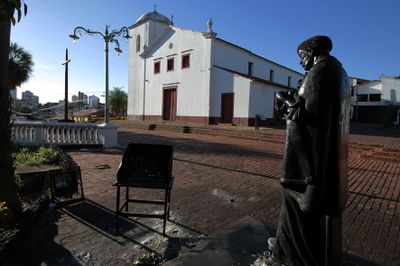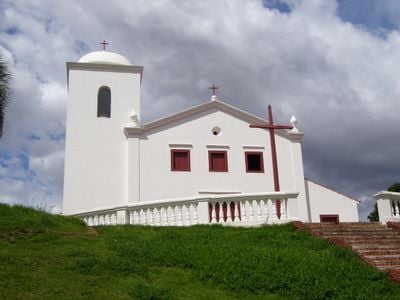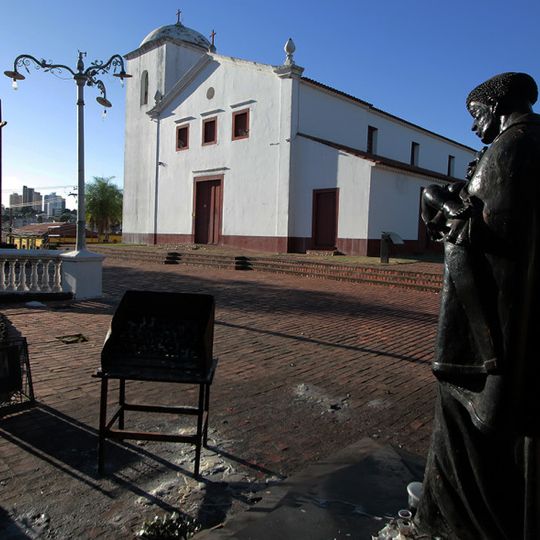
Church of Our Lady of the Rosary and Saint Benedict, Baroque church in Historic Centre of Cuiabá, Brazil.
The Church of Our Lady of the Rosary and Saint Benedict is a Catholic church in Cuiabá, Mato Grosso, built around 1730 with rammed-earth walls near the Prainha stream. Its simple colonial facade, later altered to neo-Gothic between the 1920s and 1980s, contrasts with the baroque-rococo altars inside, which have gold and silver carving found in no other church in Brazil. The building was expanded in the 18th century, and differences in clay finish are visible in the east wing.
The church was built around 1730 in rammed earth near the Prainha stream, where Miguel Sutil's gold discovery led to Cuiabá's settlement. A 1722 account by José Barbosa de Sá mentions an earlier chapel on the site. Of the city's first three churches, only this one survived demolition; it was listed by IPHAN in 1975.
The church hosts the Festa de São Benedito, the longest religious festival in Mato Grosso. The celebration joins the veneration of Our Lady of the Rosary with that of Saint Benedict, a devotion historically associated with Cuiabá's Black brotherhoods, whose earlier chapel to Saint Benedict stood nearby before being rebuilt attached to this church.
The church stands on the left bank of the old Prainha stream, in the Historic Centre perimeter listed in 1993, so it is reached on foot from the surrounding streets. The facade faces a paved square; the long white side wall with its high small windows runs to the right. The Feast of São Benedito, the state's longest religious festival, fills the surroundings, so time a visit outside it for quieter access.
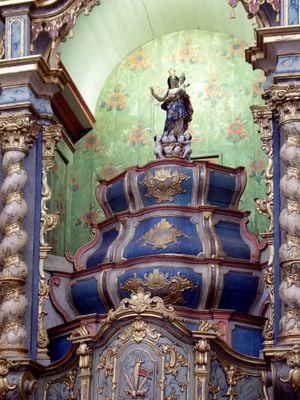
The interior houses rare stacked throne structures in bombé form that hold the central image of Our Lady of the Rosary at its center. These specialized wooden carvings represent a feature that visitors rarely encounter in other regional churches.
The community of curious travelers
AroundUs brings together thousands of curated places, local tips, and hidden gems, enriched daily by 92,857 contributors worldwide.