Lake Jackson Mounds Archaeological State Park, Archaeological state park in Leon County, Florida, United States.
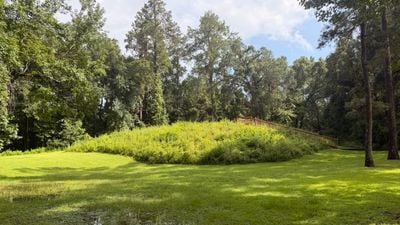
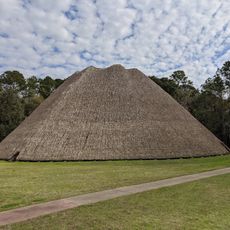
Lake Jackson Mounds Archaeological State Park preserves seven earthen platform mounds grouped around plazas, the largest rising about 11 metres and probably carrying the paramount chief's residence. Mound 3 served as a mortuary temple. A wooden walkway with a simple railing crosses one grass-covered mound; oaks draped with Spanish moss stand on and behind the earthworks.
Built and occupied between about 1050 and 1500, the site was the capital of a Fort Walton culture chiefdom and one of the largest Mississippian mound centers in the lower Southeast. After it was abandoned around 1500, the chiefdom's seat moved to Anhaica, whose residents the de Soto expedition met in 1539 as the Apalachee. Surveyors mapped "three indian mounds" here in 1852, and Florida began acquiring the property in 1966, opening the park that year; the site joined the National Register of Historic Places on May 6, 1971.
Artifacts of copper, shell, pearls, and ceramic found during excavations show how this settlement connected with other Mississippian communities across the Southeast. These trade goods reveal how distant peoples exchanged ideas and crafts.
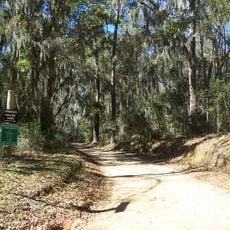
The grounds are open daily from sunrise to sunset with straightforward access to both walking trails. Wearing sturdy shoes is recommended, as the paths pass through natural terrain with elevation changes.
The park is home to Trillium reliquum, a rare plant species previously found only in neighboring states. This botanical rarity makes the location noteworthy for nature enthusiasts and plant researchers.
The community of curious travelers
AroundUs brings together thousands of curated places, local tips, and hidden gems, enriched daily by 94,047 contributors worldwide.